How to Pass a Prop Firm Challenge in 2026
Step 1: Choose the Right Firm Before You Choose a Strategy
The single biggest mistake traders make happens before they ever place a trade — they pick a firm based on price or marketing rather than data. A $39 challenge from a firm with a 4% pass rate is not cheaper than a $150 challenge from a firm with a 25% pass rate. It's significantly more expensive per successful funded account, once you do the math on how many attempts the low pass rate forces you into.
Before you buy anything, check three numbers for every firm you're considering:
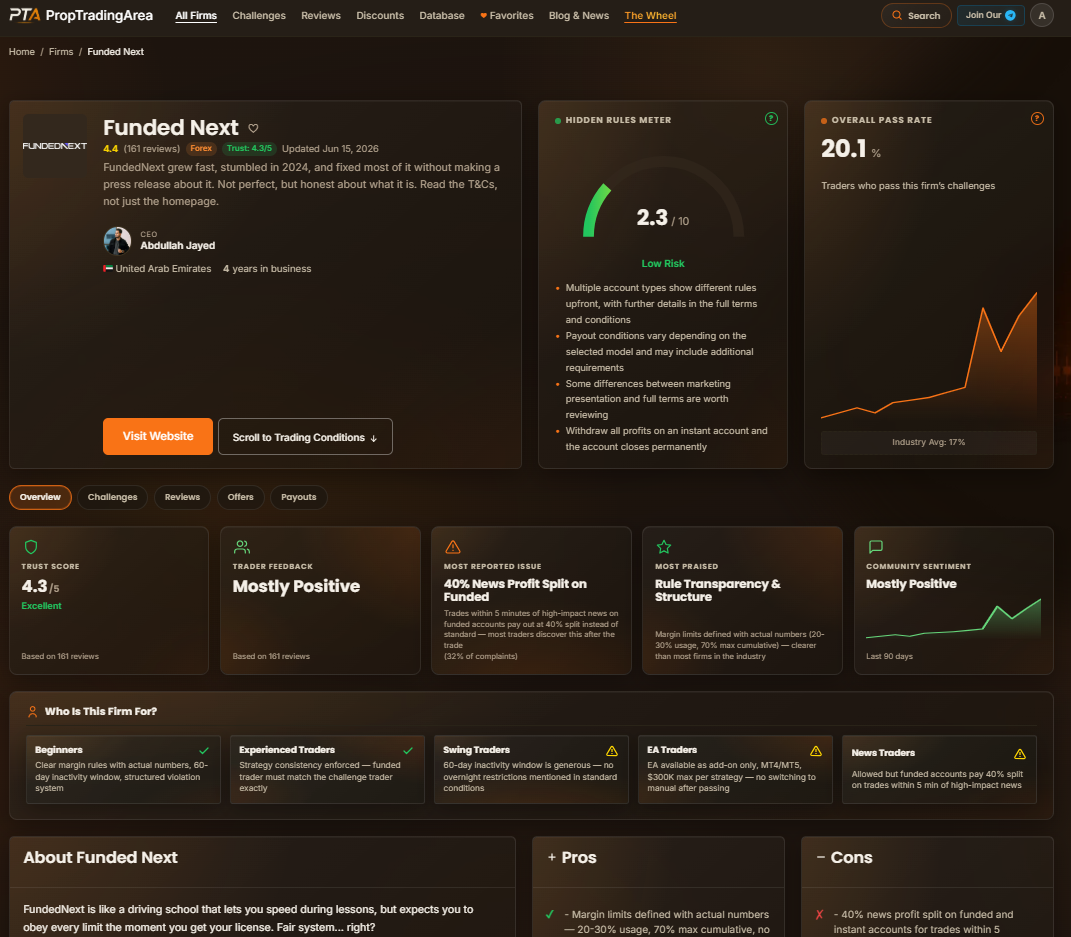
Pass Rate. Not what the firm claims on their homepage — an independently calculated pass rate based on community data and verified trader outcomes. A firm with an honest 25-30% pass rate gives you a real shot. A firm with a 5-8% pass rate is selling you a lottery ticket with extra paperwork.
Hidden Rules Meter. This tells you how many non-obvious rules exist in the T&Cs beyond the basic profit target and drawdown limit. A score above 5 means there's a meaningful chance you'll fail for a reason that wasn't clearly explained upfront — a consistency rule, a news trading restriction, a minimum holding time you didn't know existed.
Difficulty Meter. Separate from hidden rules, this measures how demanding the actual profit target and drawdown structure is. A firm can have perfectly clean, transparent rules and still have a genuinely hard evaluation. Knowing which type of difficulty you're facing — rule complexity vs raw target difficulty — changes how you should prepare.
All three of these are calculated and published for every firm listed on PropTradingArea, based on Trustpilot review analysis, community data from over 2,100 traders, and full T&C breakdowns. Check them before you spend a cent — not after you've already failed and are wondering why.
Step 2: Read the Full Trading Conditions — Not the Summary
Every firm's marketing page gives you the headline numbers: profit target, drawdown limit, profit split. What it doesn't give you is the full rulebook, and the full rulebook is where challenges actually get failed.
This is the step traders skip most often, and it's the single most preventable cause of failure. The most common rule violations that catch traders off guard:
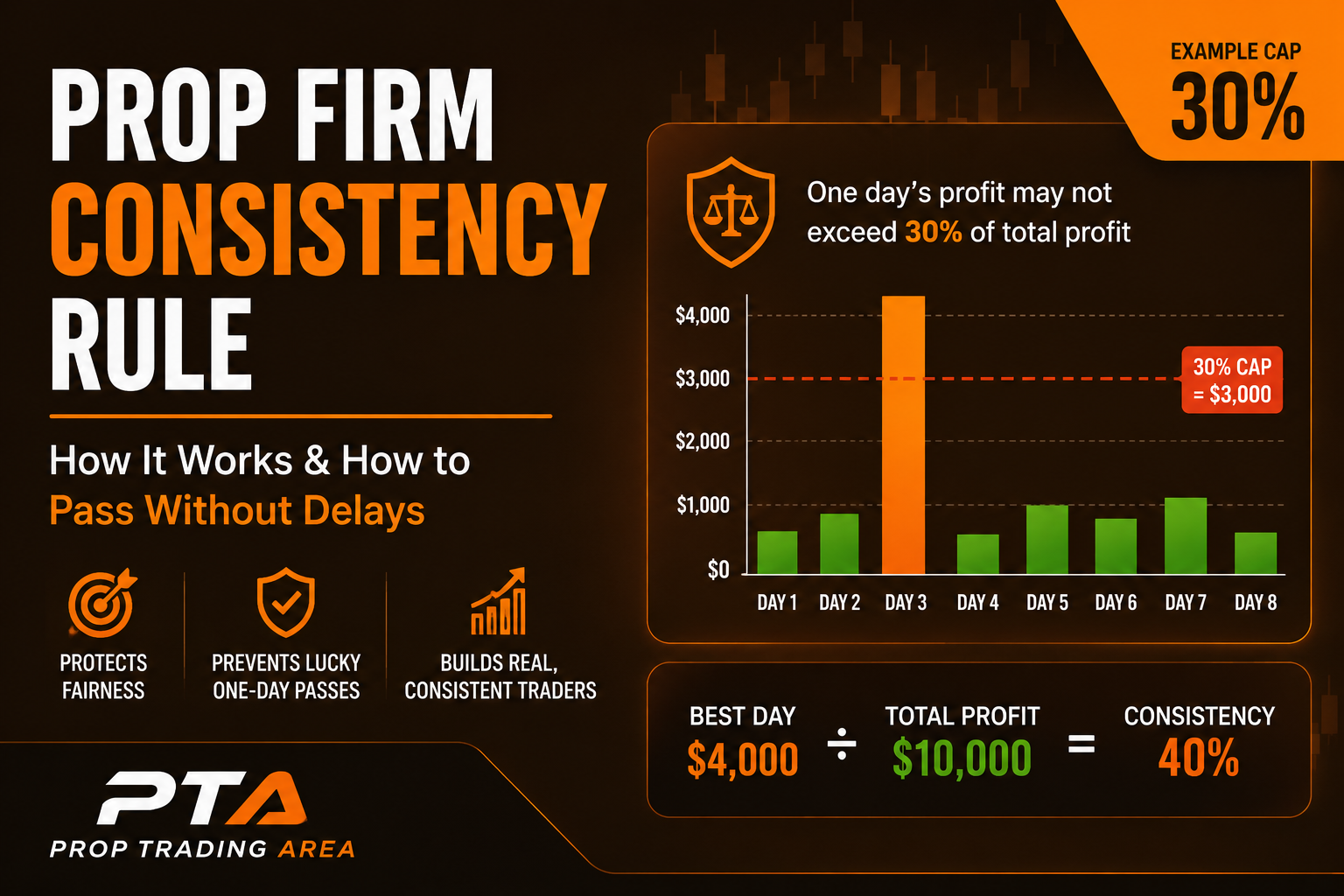
Consistency rules. Many firms cap how much of your total profit can come from a single trading day — often 20-50%. If you hit your entire profit target in one exceptional trading session, you may have just violated a rule that wasn't on the homepage.
News trading restrictions. Some firms prohibit opening or holding positions within a specific window of high-impact news events — sometimes as wide as 2-5 minutes before and after. If your strategy involves any news-adjacent trading, this rule alone can disqualify you without you realizing it happened.
Minimum holding times. A growing number of firms now require trades to be held for a minimum duration — sometimes 1-3 minutes — to prevent latency arbitrage and tick scalping. If your strategy involves fast in-and-out trades, check this before you buy.
Weekend and overnight holding rules. Some firms allow it, some don't, and some allow it for forex but not crypto, or vice versa. The rules are rarely symmetrical and rarely obvious from the marketing page.
Every firm on PropTradingArea has a full Trading Conditions section that summarizes every rule in plain English — forbidden practices, news trading policy, risk management requirements, payout conditions. Read it in full before you buy. Twenty minutes of reading can save you a failed challenge fee.
Step 3: Check the Additional Rules for Your Specific Challenge Type
Firms often offer multiple challenge models — 1-step, 2-step, instant funding, different account sizes — and the rules are not always identical across them. A firm's 2-step evaluation might have a generous drawdown policy while their instant funding model has a much stricter one.
On every firm's Challenges tab, individual challenge listings include the Difficulty Meter and pass probability specific to that account size and model, along with any additional rules that apply only to that particular structure. This is more useful than reading the general firm rules and assuming they apply uniformly — they often don't.
If you're deciding between a $10K and a $50K account, or between a 1-step and 2-step model, compare the specific rules for each rather than assuming the firm's general reputation applies equally to every product they sell.
Step 4: Match Your Strategy to the Drawdown Type
Drawdown mechanics matter more than most traders realize when choosing a firm, and getting this wrong is a common reason for failing a challenge that should have been passable.
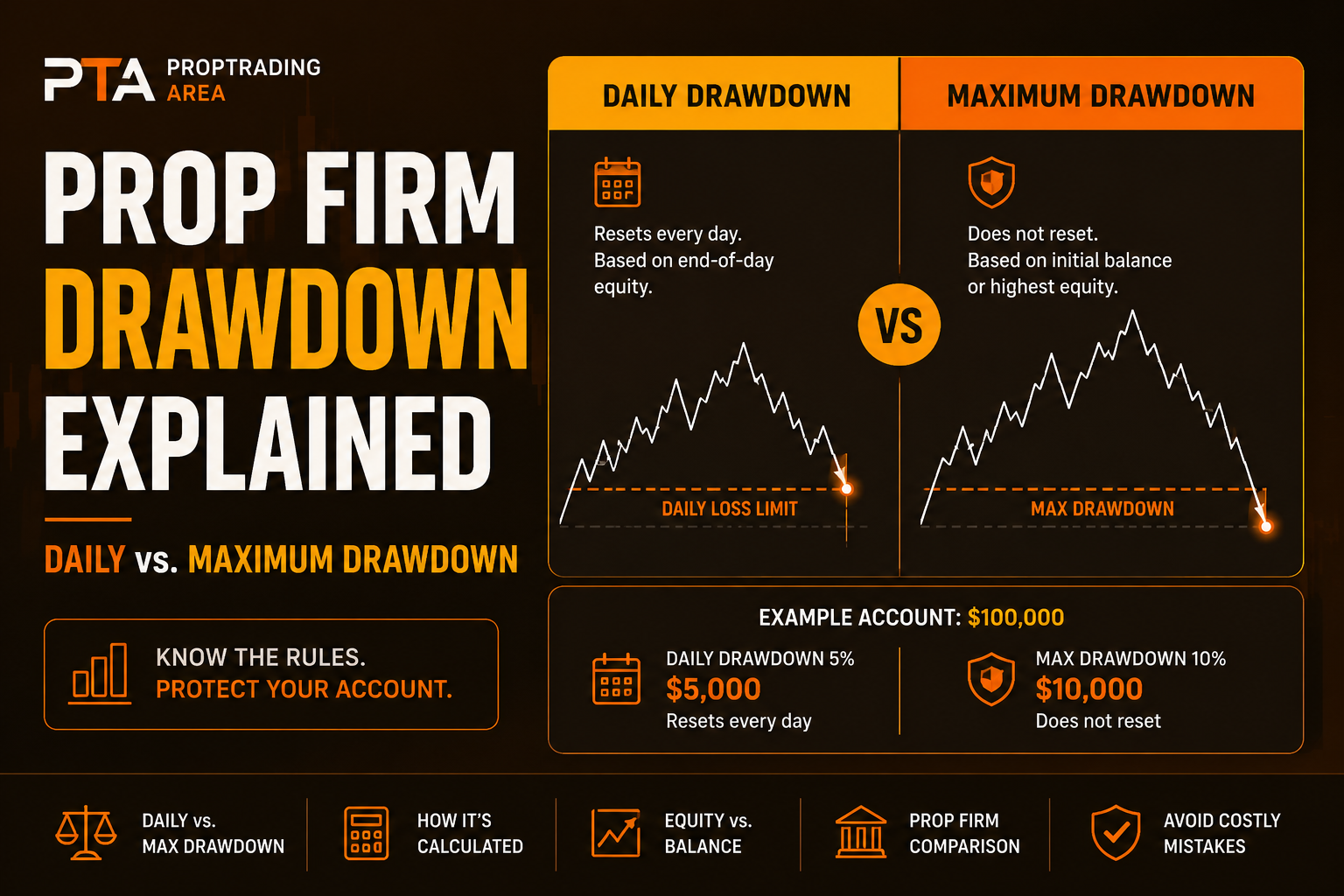
Static drawdown sets a fixed floor based on your starting balance. Simple to understand, doesn't move as you profit.
Trailing drawdown follows your equity peak in real time. If your account hits a new high, the floor moves up with it — which means a profitable open followed by a normal pullback can trigger a breach even if you eventually close the day in profit. This catches traders who build large unrealized gains and then give some back before closing.
End-of-day (EOD) drawdown resets the trailing floor based on your balance at the close of each day rather than tracking intraday peaks. This is significantly more forgiving for strategies with intraday volatility, since temporary drawdowns during the trading session don't count against you as long as you close above the limit.
If your strategy involves holding through volatility or building unrealized gains before taking profit, an EOD drawdown firm will be far easier to pass than a tight intraday trailing drawdown firm — even with identical profit targets. Check which type each firm uses before you buy, not after your account gets closed on a day where you were actually profitable at the close.
Step 5: Trade the Evaluation Like a Job Interview, Not Like Your Personal Account
This is the psychological shift that separates traders who pass from traders who don't, and it has nothing to do with technical skill.
Your personal trading account rewards aggressive position sizing when you're confident, because the upside of being right outweighs the downside of being wrong over a long enough timeline. A prop firm evaluation does not work this way. The evaluation has one job: catch you breaching a rule. It doesn't care how skilled you are over a 200-trade sample — it cares whether you survive 20-40 trades without triggering a disqualifying event.
That means:
Reduce your position size below what you'd normally trade. The goal during evaluation isn't maximum profit velocity — it's hitting the target while staying meaningfully clear of the drawdown limit. A trader who hits the profit target in 35 days with room to spare beats a trader who hits it in 8 days but breaches the drawdown limit on day 9 trying to push further.
Stop trading once you've hit the target. If your firm allows unlimited trading days, there's no reason to keep trading once you've passed. Traders who keep trading after hitting their target purely out of momentum sometimes give back the cushion that got them there.
Treat every trading day as if it could be your last one before review. Don't take a trade you wouldn't be comfortable explaining if the firm's risk team reviewed your account tomorrow. Most consistency rule violations happen because a trader took one outsized position that worked, and that single trade became a disproportionate share of their total profit.
Step 6: Plan for the Funded Stage Before You Get There
Passing the evaluation is not the finish line — it's the point where the rules often get stricter, not looser. Some firms apply consistency rules and risk limits at the funded stage that didn't exist during evaluation. Reading the firm's funded account rules before you start the evaluation means you're not surprised by a tighter rulebook the moment you actually have capital to lose.
Check specifically: does the profit split structure change at the funded stage? Are there new restrictions on EA usage, news trading, or holding periods that apply only once you're funded? Is there a payout schedule with minimum profitable days requirements? These details are documented in the full trading conditions for every firm — read them during the evaluation period, not after you've passed and are scrambling to understand new restrictions.
Common Mistakes That Cause Failed Challenges
Buying a challenge from a firm with a low pass rate because it was cheap. The fee is a small fraction of what you lose in repeated attempts.
Skipping the T&Cs because the marketing page seemed clear. The marketing page is never the full picture.
Treating drawdown limits as targets rather than limits. Getting close to the drawdown ceiling repeatedly increases your chance of an eventual breach, even if you survive each individual instance.
Increasing position size after a losing streak to "catch up" to the profit target before a deadline. This is the single most common reason traders breach drawdown limits in the final days of an evaluation window.
Ignoring the consistency rule until it's too late. Track what percentage of your total profit comes from your single best day, throughout the evaluation — not just at the end when it's already a problem.
Final Take
Passing a prop firm challenge is less about trading skill in isolation and more about choosing the right firm, understanding the exact rules you're operating under, and trading the evaluation differently than you'd trade your own capital. The traders who treat the challenge like a checklist — verified pass rate, clean hidden rules score, drawdown type that matches their strategy, full T&C review — pass at meaningfully higher rates than traders who buy based on a discount banner and figure out the rules as they go.
Check pass rates, hidden rules scores, difficulty meters, and full trading conditions for every firm before you buy your next challenge at proptradingarea.com. The data is free. The challenge fee isn't.