How Do We Calculate the Pass Rate of Each Prop Firm?
Spoiler: Not By Asking the Firms
Every prop firm comparison site on the internet ranks firms, lists features, compares prices, and tells you which one has the best discount this week. What none of them publish — and what we checked, repeatedly — is a pass rate. Not one. The number that matters most to a trader deciding where to spend $200 on a challenge is the one number nobody else is willing to show.
Why Nobody Else Publishes Pass Rates — And Why That Should Concern You
Nobody publishes pass rates. Not the big comparison sites. Not the review platforms. Not the YouTube channels dedicated entirely to prop firm content. The number that tells you how likely you are to actually get funded — the single most important metric for a trader deciding where to spend their money — is nowhere to be found.
Think about that for a second. You're about to spend $100, $200, maybe $500 on a challenge. And the one number that would most directly inform that decision doesn't exist anywhere on the internet. Until now.
You can't call yourself an "honest" prop firm comparison site when you rank #1 a firm that has 32% of its Trustpilot reviews as 1-star. That's not a ranking. That's a paid placement with a nicer color scheme. The game needs more sincerity and this industry desperately needs accountability — and that's exactly why we built what we built.
Here's exactly how we calculate it.
The Three Data Sources We Use
Our pass rate calculation pulls from three separate sources and averages them into a single number. Here's what each one contributes.
1. Trustpilot Review Analysis -> As you all know, Trustpilot has a strong software that deletes fake reviews. So all the reviews are real.
We built a proprietary tool — the PTA Trustpilot Analyzer — that scrapes verified review data from Trustpilot for every firm in our database. The tool focuses specifically on 1-star and 2-star reviews, where traders who have actually been through the evaluation process tend to describe their experience in detail. This is soon gonna be available for everyone to use - completely for free
The analyzer searches for specific keyword patterns across hundreds of reviews per firm:
Pass indicators: "passed", "got funded", "challenge passed", "funded account", "received funding", "got my funded"
Fail indicators: "failed", "blown", "breached", "violated", "hit drawdown", "account blown", "challenge failed", "didn't pass" "hidden rules"
From those keywords, we calculate a raw pass/fail ratio. We then apply a correction factor to account for the fact that traders who pass are significantly more likely to leave a review than traders who fail — creating a natural positive bias in the data. The corrected ratio gives us a community-derived pass rate estimate.
Because we focus on negative reviews, we also extract a payout complaint rate — the percentage of reviews that mention denied payouts, withdrawal issues, or fraud. This feeds directly into our Hidden Rules scoring.
2. PropTradingArea Community Data
Our community on PropTradingArea currently consists of over 2,100 traders who post their accounts, challenge results, and payouts publicly. This isn't a survey. These are real traders documenting real outcomes in real time.
From this community data, we track:
— How many traders report passing a specific firm's challenge
— How many report failing, and at what stage
— How many report payout issues after passing
— Which rules caused the most disqualifications
Community data has a different bias than Trustpilot data — traders in our community tend to be more engaged and more experienced than the average challenge buyer. So a firm's community pass rate tends to be slightly higher than the Trustpilot-derived rate. We account for this in our weighting.
3. T&C Analysis and Structural Difficulty Assessment
The third input isn't a pass rate at all — it's a difficulty assessment derived from reading the actual terms and conditions of each firm. We read every T&C document. All of them. Every rule, every footnote, every definition of "trading day."
From this analysis, we score each firm on our Hidden Rules Meter — a 0 to 10 scale that measures how many non-obvious rules exist in the evaluation, how likely those rules are to catch traders who think they're compliant, and how clearly those rules are communicated upfront.
A firm with a Hidden Rules score of 7.1 — like one firm currently in our database (you probably know who we're talking about) — has a fundamentally different structural pass rate than a firm with a score of 1.3. The T&C analysis helps us calibrate our community and Trustpilot data against the actual difficulty of passing each specific firm's evaluation.
How We Combine the Three Sources
Each of the three data sources has different strengths and different biases. Trustpilot data is broad but biased toward vocal traders. Community data is accurate but skewed toward experienced traders. T&C analysis is objective but doesn't capture execution — a firm can have clean rules and still fail traders through discretionary enforcement.
We weight the three sources as follows:
Trustpilot Analyzer data: 40% — largest sample size, most representative of the general trader population
PTA Community data: 40% — Most verifiable on our side: real accounts and real outcomes
T&C structural assessment: 20% — calibration factor, adjusts for firms whose rules are more or less punishing than community data alone would suggest
The weighted average of these three inputs is what you see as the Overall Pass Rate on every firm profile on PropTradingArea.
The 95% Myth — And What the Data Actually Shows
You've probably heard the statistic thrown around: 95% of traders lose. It's repeated so often it's become industry gospel. But here's a question nobody seems to ask — if only 5% of traders are profitable, why do prop firms keep adding rules? And why do they become tighter and tighter?
Think about it. If the vast majority of traders were genuinely unprofitable, prop firms wouldn't need consistency rules, lot size restrictions, news trading bans, minimum trade duration requirements, or the seventeen other constraints that have quietly appeared in T&Cs over the last three years. You don't build an increasingly complex rulebook to stop people who were never going to pass anyway...right?
You build it to stop people who were.
The pass rate data we collect tells a more nuanced story than "95% of traders lose." It tells us that a meaningful portion of traders are perfectly capable of hitting profit targets — and that a significant chunk of disqualifications happen not because traders failed to trade profitably, but because they violated a rule they didn't know existed. That's not a skill problem. That's an information problem. And it's exactly the problem PropTradingArea was built to solve.
What the Hidden Rules Meter Adds
Pass rate tells you how many traders get through. Hidden Rules Score tells you why the rest don't.
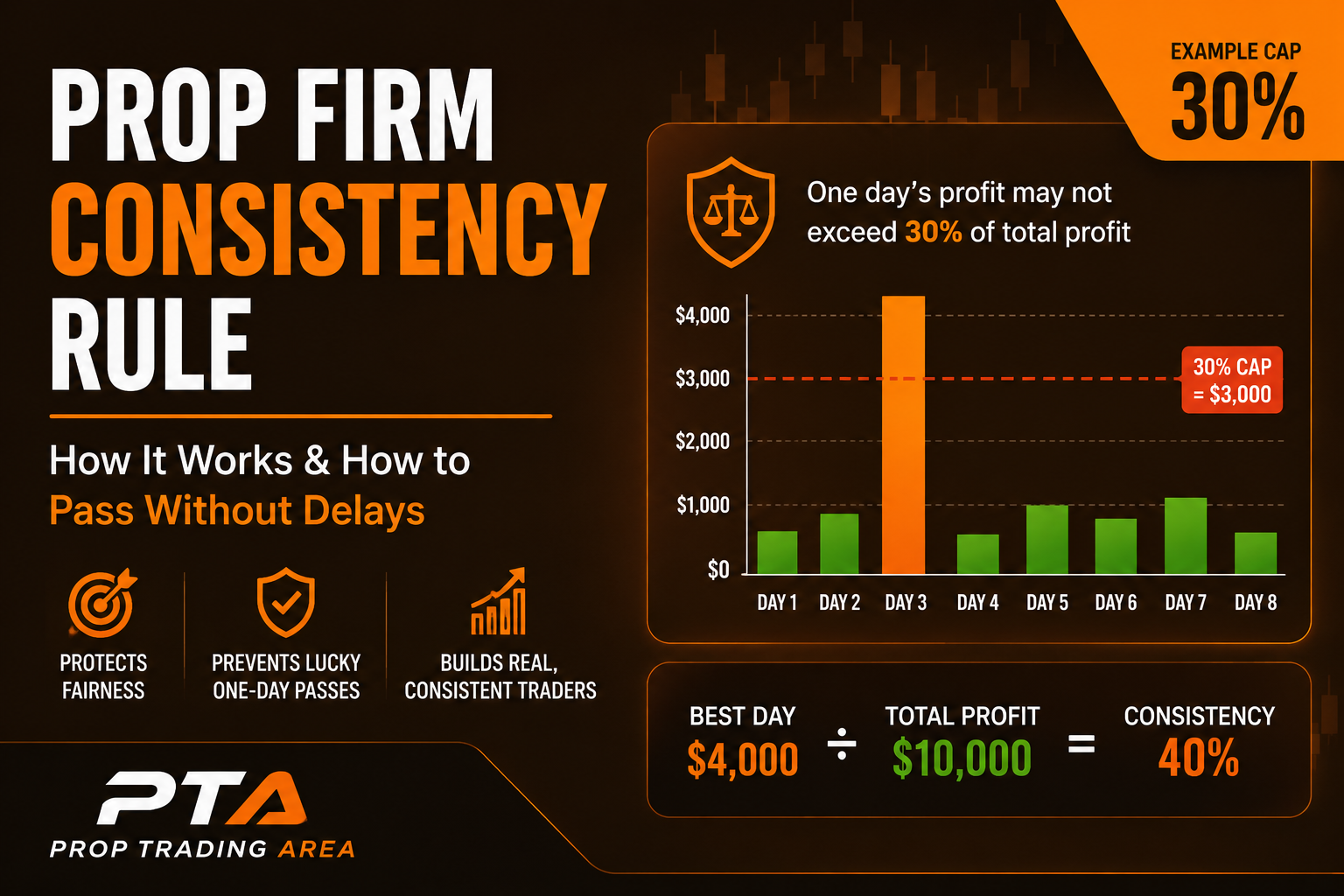
A firm can have a 20% pass rate for two very different reasons. One firm might have a 20% pass rate because the profit target is genuinely challenging — traders need real skill to hit 10% without breaching a 5% drawdown. That's a fair evaluation. Another firm might have a 20% pass rate because buried in section 14.3 of their T&Cs is a consistency rule that invalidates any day where a single trade represents more than 40% of total session profit — a rule most traders don't discover until their account is already closed.
The Hidden Rules Meter scores firms on:
— Number of non-standard rules beyond basic profit targets and drawdown limits
— Clarity of rule communication on the firm's website VS. what actually exists in the T&C
— History of rule-based disqualifications reported in community data and Trustpilot reviews
— Consistency of rule enforcement — whether the same rule is applied the same way across all traders
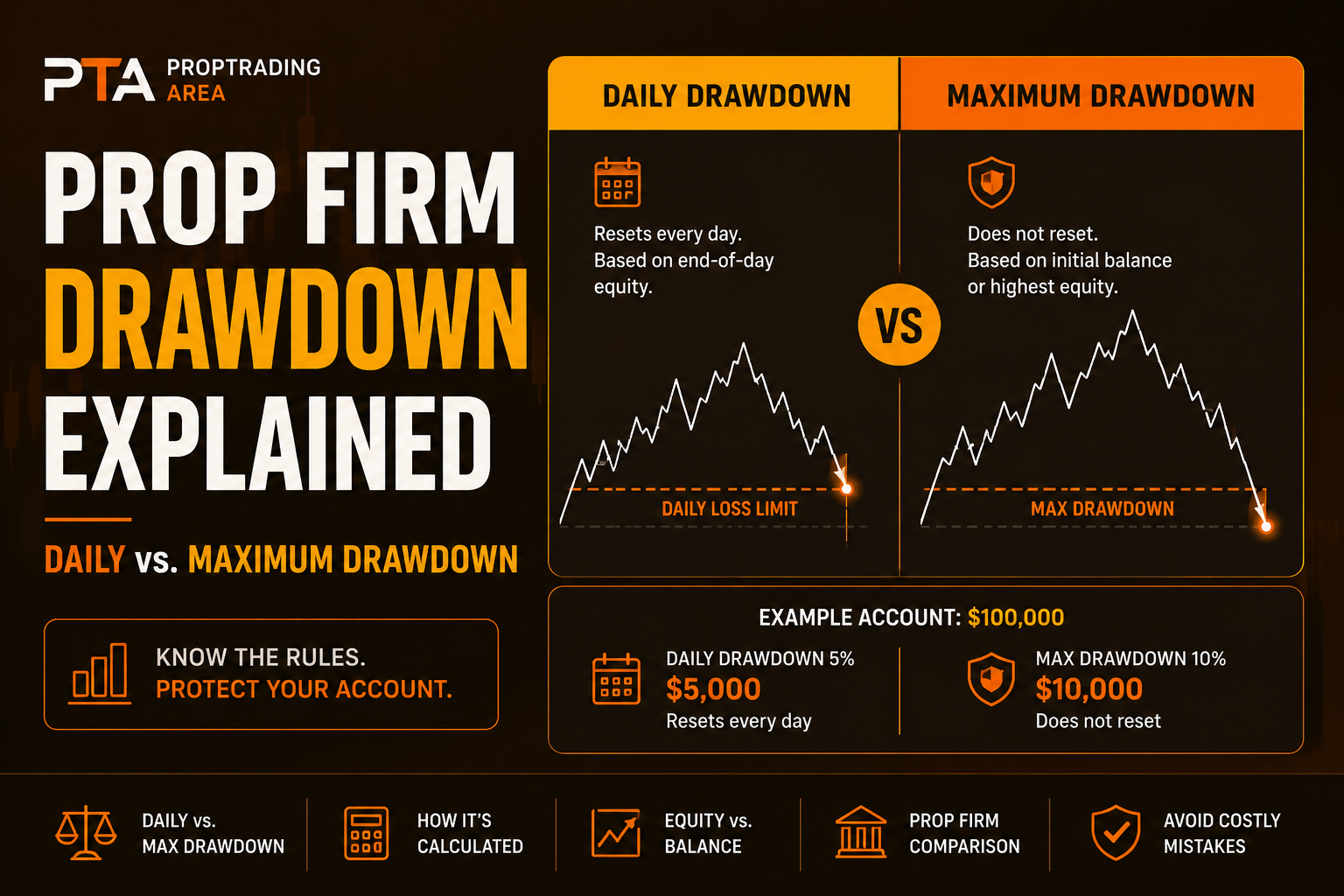
A score of 0-2 means the firm's rules are straightforward and clearly communicated. A score of 5-7 means there are meaningful hidden rules that a significant portion of traders will violate without knowing they exist. A score above 7 means the T&C is actively working against you — and the pass rate reflects it.
Why This Matters More Than You Think
Here's a number worth sitting with: the average pass rate across all firms in our database is under 20%. That means more than 4 out of every 5 traders who buy a challenge don't pass it. Some of those failures are legitimate — the traders weren't ready, their strategy didn't fit the rules, they took too much risk. That's how evaluations are supposed to work.
But a meaningful portion of those failures happen because traders didn't know what they were agreeing to. They read the headline — "10% profit target, 5% max drawdown" — and didn't read the seventeen other rules that sit between them and a funded account. Our Hidden Rules Meter exists to close that gap. Our pass rate methodology exists to give you a number you can actually trust.
The firms with the highest pass rates on our platform —, FTMO at 24.1%, E8 Markets at 23.3% — earned those numbers. They have clean T&Cs, consistent enforcement, and community data that matches their structural difficulty. The firms at the bottom of the list — with pass rates under 10% and Hidden Rules scores above 5 — are there because the data puts them there, not because we have an opinion about them.
We have pass rates for all 36 firms currently listed on PropTradingArea, updated regularly as community data grows and Trustpilot review pools expand. Check the full rankings at proptradingarea.com.