What Is a Prop Firm? The Beginner's Complete Guide (2026)
Look, if you've been trading for a while and keep seeing "prop firm" everywhere — Reddit threads, YouTube thumbnails, Discord servers — and still aren't entirely sure what it means or whether it applies to you, this is the article for you. No assumptions about what you already know. Just the full picture, from what a prop firm is to how to pick one without making the mistakes most beginners make in the first month.
What Is a Prop Firm?
A proprietary trading firm — prop firm for short — is a company that provides traders with funded trading accounts in exchange for a share of the profits those traders generate. Instead of trading your own money, you trade the firm's capital. If you make money, you keep a percentage. If you lose money, you lose the account — not your personal savings.
The model exists because there are profitable traders in the world who don't have enough capital to make meaningful returns on their own account sizes, and there are firms with capital who want exposure to those traders' performance without hiring them full-time. The funded account is the middle ground.
In practice, most prop firms today operate in one of two markets: Forex and CFDs (currencies, indices, commodities, metals) or Futures (standardized exchange-traded contracts on the same underlying markets). The rules, platforms, and account structures differ significantly between the two, which is why we cover them separately on PropTradingArea.
How Do Prop Firm Challenges Work?
Most prop firms don't just hand you a funded account. First, you pay a fee — typically between $50 and $600 depending on the account size — and complete an evaluation called a challenge. The challenge tests whether you can hit a profit target while staying within specific loss limits. Pass it, and you get access to a funded account. Fail it, and you either reset (pay again) or walk away.
The most common challenge structures are:
▪ 2-Step Challenge — two phases, each with a profit target. Phase 1 is typically higher (8-10%), Phase 2 lower (5%). Pass both and you're funded. The most common structure in the industry.
▪ 1-Step Challenge — one phase, single profit target. Usually faster to complete but sometimes with stricter rules or lower profit splits on the funded account.
▪ Instant Funding — no challenge. You pay a higher fee and start trading a funded account immediately, usually with tighter risk limits than standard challenges.
▪ 3-Step and 4-Step — less common, usually found at firms targeting more conservative, longer-track-record traders.
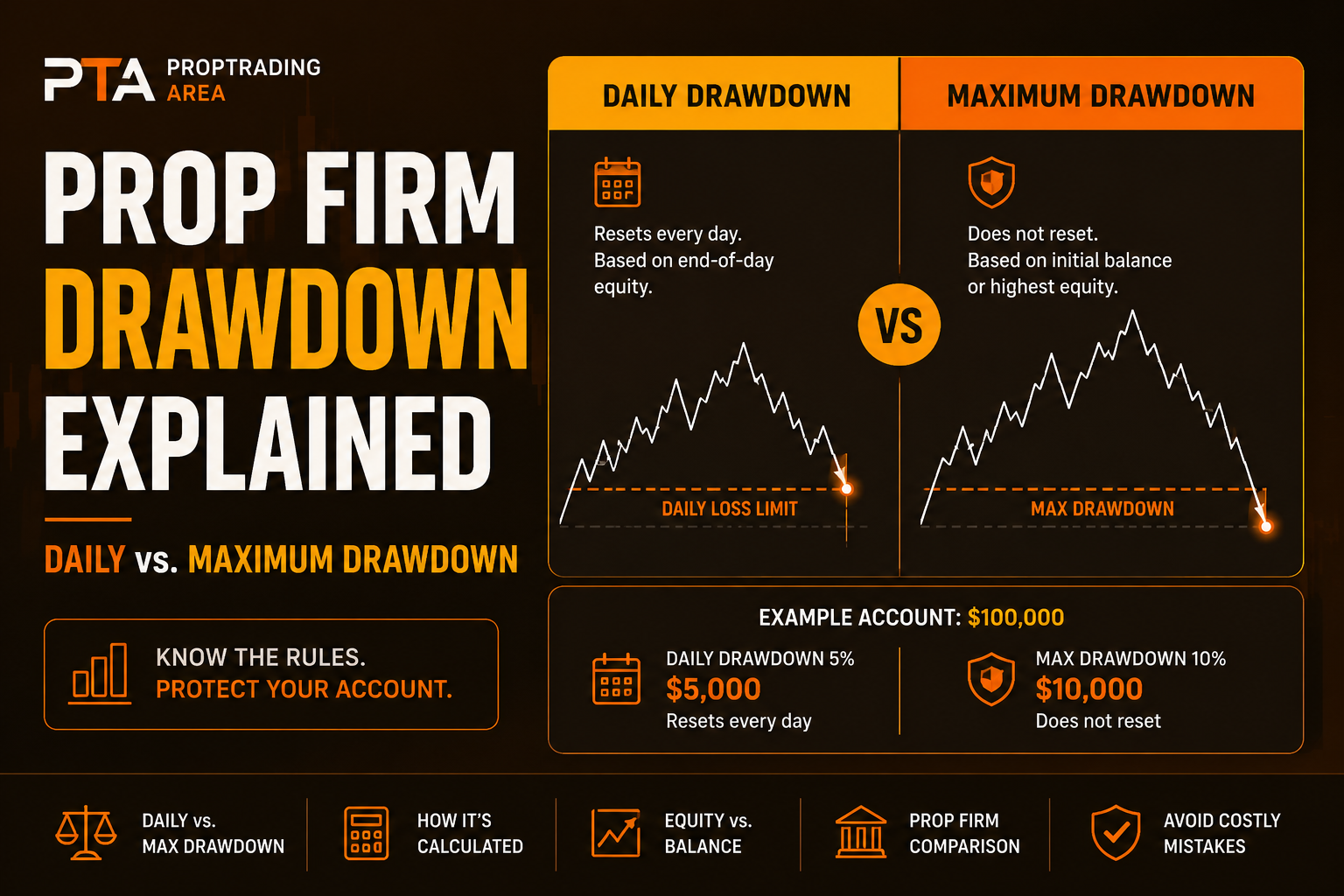
Every challenge has two loss limits you need to stay within: a daily loss limit (how much you can lose in a single day) and a maximum loss limit (how much you can lose from the starting balance overall). Breach either one and the challenge ends — no refund, no partial credit.
The profit target and loss limits are set as percentages of the account size. A typical 2-step challenge at $10,000 might require a 10% profit ($1,000) in Phase 1 while keeping daily losses under 5% ($500) and total losses under 10% ($1,000). On paper that sounds straightforward. In practice, the combination of rules — including ones that aren't on the pricing page — is what catches most traders out.
What Happens After You Pass?
Once you pass the challenge, the firm issues you a funded account — typically the same size as the challenge account, though some firms scale you up. You trade it according to the funded account rules (which may differ from the challenge rules — more on that below), and when you hit a profit, you request a payout.
Payout splits vary by firm and plan. Most range from 70% to 90% in the trader's favor, with some firms offering up to 100% on premium plans. Some firms refund the challenge fee with your first payout. Others pay weekly, bi-weekly, or monthly — the frequency affects how quickly you can compound or withdraw.
Before your first payout, almost every firm requires KYC verification — uploading a government ID and sometimes completing a video interview. This typically takes 48-72 hours. It's worth knowing this upfront because traders who expect instant payouts after passing are often surprised by the verification step.
Forex vs Futures — Which Is Right for You?
This is the first real decision you'll need to make, and it's worth spending a few minutes on.
Forex/CFD prop firms are more common, with more firms to choose from, lower challenge fees, and wider instrument variety — you can trade currency pairs, indices like S&P 500 or DAX, gold, oil, and more. The downside: Forex prop firms operate in a less regulated environment. They typically use simulated accounts rather than live market exposure, and their rules can be more complex and varied between firms.
Futures prop firms trade standardized exchange contracts — ES (S&P 500), NQ (Nasdaq), CL (Crude Oil), GC (Gold), and others. The market structure is more transparent, the rules tend to be simpler, and execution is on real exchanges. Challenge fees are generally higher and account sizes are measured in contracts rather than dollar amounts. If you're already familiar with futures trading, a futures prop firm is often a cleaner environment.
If you're starting from scratch, most traders begin with Forex prop firms for the lower entry cost and wider firm selection, then move to futures once they have a clearer strategy.
What Are Hidden Rules?
This is the part most beginner guides skip, and it's the most important section on this page. A hidden rule is any rule that affects whether you pass the challenge or get your payout — but isn't prominently disclosed on the pricing or FAQ page most traders actually read.
The most common hidden rules include:
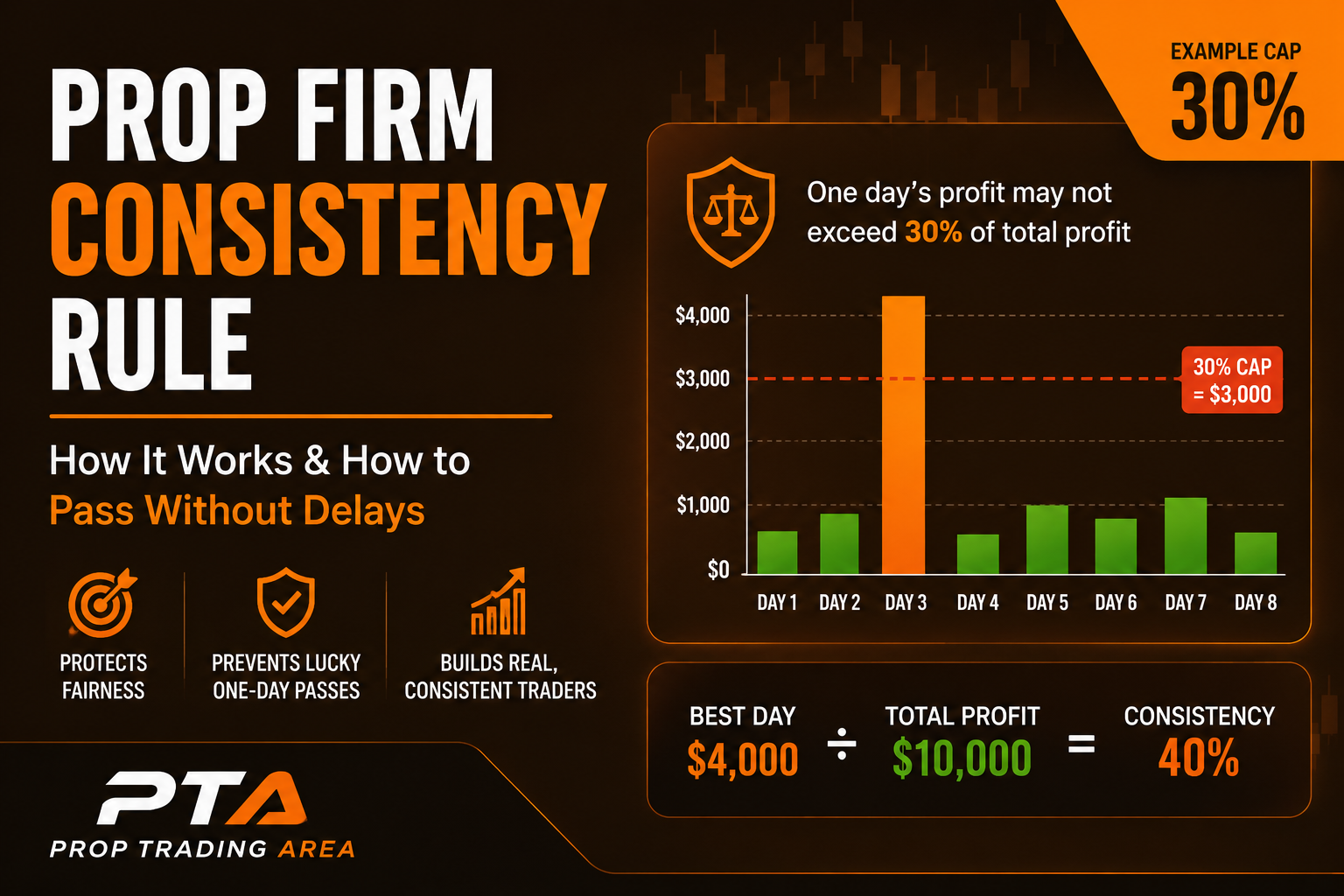
▪ Consistency rules — limits on how much of your total profit can come from a single trading day (typically 30-50%). If one great NFP trade makes up 40% of your monthly profit on a funded account, your payout may be delayed.
▪ News trading restrictions — blackout windows before and after major news releases where you can't open, close, or modify trades on affected instruments.
▪ EA restrictions — many firms that "allow EAs" only allow them on certain account types, with pre-approval, or exclude automation entirely.
▪ Non-disparagement clauses — some firms include terms that restrict you from making negative public statements about them, with account suspension as a potential consequence.
▪ KYC interview requirements — mandatory video calls before your first payout that some firms don't mention until you've already passed.
PropTradingArea scores every firm on a 0-10 Hidden Rules Meter based on how transparent or potentially tricky their terms are. A score of 0-2 means clean, readable rules. A score above 5 means there are clauses worth reading carefully before you pay. You can read the full breakdown in our Prop Firm Hidden Rules — Complete Guide.
Pass Rates — What Do They Actually Mean?
Every prop firm marketing page implies that if you're a good trader, you'll pass. What none of them publish is the percentage of traders who actually do. PropTradingArea calculates this independently.
The industry average pass rate across the firms we track sits at around 18-20%. That means roughly 4 out of 5 traders who buy a challenge don't complete it. Some of that is skill. Some of it is challenge structure — firms with aggressive daily loss limits, consistency rules, or minimum trading day requirements will naturally produce lower pass rates regardless of trader quality.
A low pass rate isn't automatically a red flag — it might mean the challenge is genuinely hard, which is different from being unfair. A high pass rate isn't automatically a good sign either — some firms with generous parameters have high pass rates but strict funded account rules that catch traders later. The pass rate combined with the hidden rules score gives you a more complete picture than either metric alone.
You can read exactly how we calculate pass rates — and why the "95% of traders fail" stat that firms use in their marketing tells only half the story — in our How We Calculate Prop Firm Pass Rates article.
How to Choose a Prop Firm as a Beginner
Five things worth checking before you pay for any challenge:
▪ Does the challenge structure match how you actually trade? If you're a swing trader who holds positions for days, a firm with a 30-day time limit and a trailing drawdown is a worse fit than one with no time limit and a static floor.
▪ Read the funded account rules, not just the challenge rules. Most pricing pages describe the challenge. The funded account rules are often on a separate page and sometimes more restrictive — especially around consistency, news trading, and payout timing.
▪ Check the hidden rules score. On every firm's profile on PropTradingArea you'll find the Hidden Rules Meter score and the specific clauses that drove it. Spend two minutes here before you spend $200 on a challenge.
▪ Look at community feedback, not just Trustpilot averages. A 4.2 Trustpilot rating sounds fine. 28% one-star reviews with a pattern of payout complaints tells a different story. Both numbers can coexist because positive reviews tend to come immediately after passing, negative reviews come later after payout issues.
▪ Start small. Buy the smallest account size first, not the biggest. A $5,000 or $10,000 challenge costs less to reset if you make mistakes, and the percentage-based rules are identical to a $100,000 account. Get familiar with the firm's environment before scaling up.
For a curated list of the most beginner-friendly firms across both Forex and Futures, see our Best Prop Firms for Beginners 2026 guide.
Common Mistakes Beginners Make
A few patterns that show up consistently in the community data:
Buying the biggest account available first. The rules are the same at every account size — the only difference is the dollar amounts. A $200,000 challenge costs 10-20x more to reset than a $10,000 one and teaches you nothing faster.
Not reading the funded account rules before buying the challenge. The funded account is where the money is. Read those terms first, then decide whether the challenge is worth attempting.
Trading differently during the challenge than you normally would. Challenges are designed to be completed with a consistent, sustainable strategy. Traders who change their risk per trade, hold times, or instrument selection specifically to pass the evaluation often fail or get flagged when those patterns shift on the funded account.
Chasing the highest profit split. A 90% split at a firm with a 3.8% pass rate and aggressive consistency rules may net you less than an 80% split at a firm where you actually get paid. Pass rate and hidden rules matter more than the headline split percentage.
Ignoring the payout track record. A firm that's been paying traders consistently for three years is meaningfully different from one that launched six months ago. Check the community data.
The Firms Worth Starting With
If you want specific starting points, these are the firms that consistently perform well on both pass rate and hidden rules scoring across their beginner-suitable account tiers:
For Forex: E8 Markets, Funding Pips, and FundedNext all have low hidden rules scores, readable terms, and pass rates at or above the industry average.
For Futures: Earn2Trade and Elite Futures are the most consistently recommended starting points for traders new to futures prop evaluation structures.
Full profiles for every firm mentioned — including trading conditions, community snapshot, and the current pass rate — are on their individual pages linked above.
Final Verdict
idk man — prop trading is a real path to trading larger capital than you'd have access to otherwise, and the model has matured significantly since 2020. The firms that survived 2023-2025 are generally operating more transparently than the ones that didn't. But the industry still has a long tail of firms with aggressive hidden rules, low pass rates, and payout track records that don't hold up under scrutiny.
The information to tell them apart exists — it's just scattered across T&C PDFs, Reddit threads, and Trustpilot pages that most traders never read. That's what PropTradingArea exists to aggregate. Start with the Hidden Rules score, cross-reference with the pass rate, and read the funded account rules before you pay. Everything else is secondary.