Which Account Size Do Traders Actually Choose? Data From 2,159 Real Traders
Everyone has an opinion about which prop firm account size you should buy. The YouTuber with 50K subscribers says go big or go home. The Discord veteran says start small. The prop firm's own website conveniently recommends whatever size has the highest margin. At PropTradingArea, we decided to skip the opinions and look at what 2,159 traders in our community actually do — traders who post their accounts and payouts publicly, which means the data isn't theoretical. These are real people spending real money on real challenges. Here's what they chose, why it probably makes sense, and where the community is collectively making avoidable mistakes.
The Account Size Breakdown
According to PropTradingArea community data — comprised of 2,159 traders who post their accounts and payouts — here's how account size preference breaks down:
| Account Size | % of Traders |
|---|---|
| $10,000 | 38% |
| $25,000 | 21% |
| $50,000 | 16% |
| $100,000 | 11% |
| $200,000 | 7% |
| $400,000+ | 7% |
The headline number: 38% of traders choose the $10K account. More than one in three. Which is either a sign of responsible risk management or a sign that most traders are doing what most traders do — starting with the cheapest option available and hoping it goes well. Probably both.
The $10K Account — The Industry's Comfort Blanket
38% of the community picks the $10K account, making it by far the most popular choice. This is the prop trading equivalent of ordering the house wine — not because it's the best option, but because the downside is manageable if it turns out to be terrible.
The math is straightforward: a $10K challenge typically costs between $50 and $150 depending on the firm and evaluation type. If you fail, you've lost the cost of a decent dinner out. If you pass, you have a funded account that — at a standard 80% profit split — means you're keeping roughly $800 on every $1,000 in profit. That's not going to replace your salary, but it's a real number that proves the model works before you commit to something larger.
The honest critique of the $10K crowd: a significant portion of these traders are buying $10K accounts not because they've done the math and decided it's the right entry point — but because they're not confident enough in their own trading to risk more. That's not a strategy. That's anxiety with a platform login. If you've been trading profitably on demo for six months and your only hesitation is the challenge fee, the $10K account is probably undersizing your actual skill level.
Who should choose $10K: Traders genuinely new to prop firm evaluations, traders testing a specific firm's rules before scaling, and traders who want to prove the model works before committing. That's like dating someone for a month before meeting their family — completely reasonable.
Who shouldn't choose $10K: Experienced traders using it as a permanent comfort zone. If you've passed five $10K challenges and keep buying more instead of scaling up, you're leaving money on the table and calling it caution.
The $25K Account — The Sweet Spot Nobody Talks About
21% of the community lands on $25K, making it the second most popular choice. This is the account size that makes the most mathematical sense for the widest range of traders, and it's consistently underrepresented in community discussions dominated by people flexing $200K accounts or complaining about failing $10K challenges.
A $25K challenge fee typically runs between $150 and $250. The profit potential is 2.5x the $10K account with a fee increase of roughly 1.5–2x — meaning the cost-to-upside ratio is actually better than the $10K. At 80% profit split, every $1,000 in monthly profit is $800 in your pocket, and the position sizes you can run on a $25K account are large enough to make trading feel like a real professional activity rather than a hobby with paperwork.
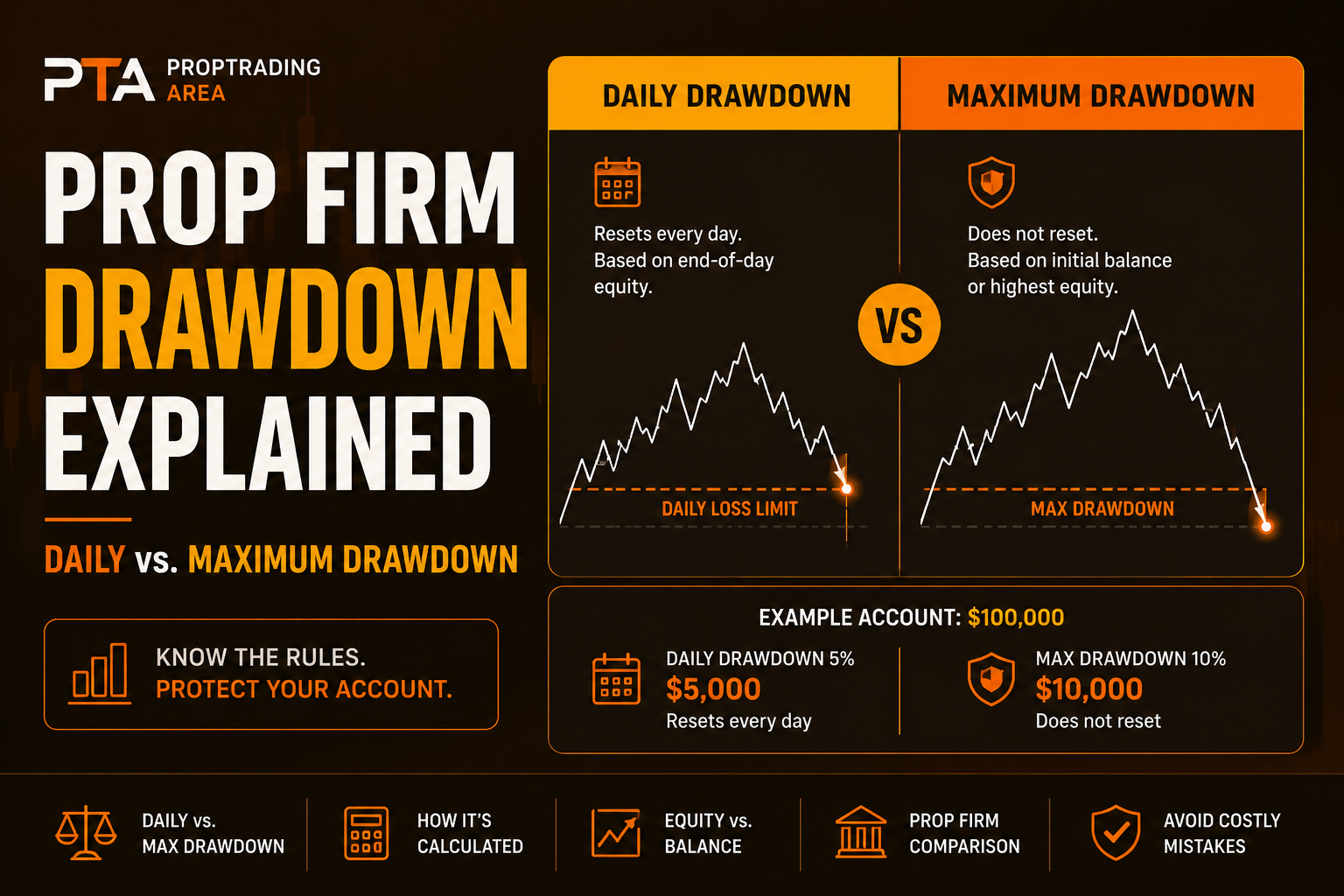
The $25K account is also the size where drawdown rules start to feel meaningful rather than arbitrary. A 5% maximum drawdown on $10K is $500. On $25K it's $1,250 — enough room to trade a real strategy through normal market volatility without feeling like you're navigating a minefield in socks.
Who should choose $25K: Traders with at least 3–6 months of consistent demo or live trading results who understand their average drawdown and can demonstrate that it fits within the firm's limits. That's like knowing your alcohol tolerance before you agree to an open bar — basic self-awareness that saves everyone a lot of trouble.
The $50K Account — Where Things Get Serious
16% of the community chooses $50K — the account size where the transition from "testing the model" to "this is a real trading operation" happens. Challenge fees here typically range from $300 to $500, and the profit potential starts to resemble something a professional trader would find worth their time.
The $50K account is where trading discipline becomes non-negotiable. A 5% drawdown limit on $50K is $2,500 — which sounds like a lot of room until you're in a volatile week and realize you've used 60% of it by Wednesday. Traders who survived $10K and $25K challenges on discipline and luck tend to get exposed at $50K, because the position sizes required to hit profit targets without blowing drawdown limits demand genuine risk management, not just careful clicking.
The community data point worth noting: there's a meaningful drop between $25K (21%) and $50K (16%). That 5-percentage-point gap represents traders who looked at the $50K challenge fee, did the math on their win rate, and decided the expected value wasn't there yet. That's not cowardice — that's exactly the kind of self-assessment that separates traders who last in this industry from those who don't.
Who should choose $50K: Traders with a documented track record of at least 3 months of profitable trading, a defined strategy with known drawdown characteristics, and enough capital to fund multiple challenge attempts if the first one doesn't go to plan. Think of it like renovating a house — you go in with a budget, you expect it to cost more than that, and you have a plan for when it does.
The $100K Account — The Prestige Play
11% of the community chooses $100K. This is where the numbers start to feel real in both directions — real profit potential, real challenge fees ($500–$1,000+), and real consequences for treating risk management as optional.
A $100K funded account at 80% profit split means you're keeping $800 on every $1,000 of profit. A trader hitting 5% monthly profit on a $100K account — $5,000 — takes home $4,000. That's a meaningful income supplement for most people and a livable income for traders in lower cost-of-living markets. It's also exactly the number that makes traders overconfident, because the potential starts to feel so real that the risk management that got them there starts to feel like an obstacle.
The honest observation about the 11% who choose $100K: a portion of them are experienced traders who have earned the right to operate at this size. Another portion are traders who decided to skip the smaller sizes, reasoning that if they're going to do this properly they might as well start properly. That's like deciding your first car should be a sports car because you're a good driver. Sometimes it works out. Often it doesn't, and the repair bill is proportionally larger.
Who should choose $100K: Traders who have passed at least one smaller evaluation, have a strategy with documented performance, and understand that a $100K challenge fee is a business expense — not a lottery ticket.
The $200K and $400K+ Accounts — The Top of the Mountain
7% of the community chooses $200K accounts and another 7% goes for $400K or above. Combined, that's 14% of traders operating at sizes where a single good month can generate more than many people's annual salary — and where a single undisciplined week can erase it.
These traders are, in general, not the same people who are buying $10K accounts hoping to figure it out. The community data shows that traders at these sizes tend to have prior funded account experience, defined strategies, and a business-like approach to challenge fees as operating costs rather than gambling stakes. They're also, statistically, more likely to have been trading for longer — which means they've already made the expensive mistakes at smaller sizes and are now applying what they learned.
The $400K+ category deserves a specific note: at this size, firm selection becomes critical in a way it isn't at $10K. A firm with a Hidden Rules score of 5.9 is a minor inconvenience at $10K. At $400K, the same hidden rules can cost you tens of thousands in disputed payouts. Traders operating at this level should be reading T&Cs the way lawyers read contracts — because at this size, the details in the fine print are denominated in amounts that actually matter.
Who should choose $200K–$400K+: Experienced traders with multiple funded account completions, a proven strategy, and the emotional discipline to treat a bad week as data rather than a catastrophe. That's not most traders. And that's fine — the $10K account exists for a reason.
Evaluation Type — What the Community Prefers
Account size is only half the picture. How traders choose to get funded matters just as much as how much they're funded with. Here's the community breakdown on evaluation type:
| Evaluation Type | % of Traders |
|---|---|
| 2-Step Evaluation | 36% |
| 1-Step Evaluation | 31% |
| 3-Step Evaluation | 8% |
| 4-Step Evaluation | 6% |
| Instant Funding | 19% |
The 2-step evaluation leads at 36%, which makes sense — it's been the industry standard long enough that most traders know exactly what to expect. Two phases, defined targets, defined drawdown limits, pass both and you're funded. Predictable enough to plan around, demanding enough to filter out traders who aren't actually ready.
The 1-step evaluation at 31% reflects the industry's drift toward simplicity. One phase, one target, faster to completion. The appeal is obvious — why do something twice when once is sufficient? The tradeoff is that 1-step evaluations typically have tighter profit targets or stricter drawdown rules to compensate for the reduced evaluation period. Faster isn't always easier. It's just faster.
The 19% choosing Instant Funding is the most interesting data point in the entire survey. These are traders who skip the evaluation entirely — pay a higher monthly fee, get a funded account immediately, and trade from day one. That's like skipping the driving test and paying extra for insurance instead. The logic isn't entirely wrong — if you're a profitable trader, why prove it to a firm over 30 days when you can just start trading? The answer is that instant funding accounts typically have lower profit splits, higher monthly costs, and stricter ongoing rules than evaluation-based accounts. The convenience premium is real and ongoing.
The 3-step (8%) and 4-step (6%) evaluation traders are a special category: people who either chose a firm with unusual evaluation structures or are scaling through a firm's internal progression system. These traders tend to be methodical to a fault — the type who reads the entire terms and conditions document before clicking "I Agree," which in this industry is not actually a fault at all.
What the Data Actually Tells Us
Combining account size and evaluation type preferences reveals a clear community profile: the average PropTradingArea trader is cautious, deliberate, and oriented toward proven structures over experimental ones. The $10K + 2-step combination is almost certainly the most common single pairing in the data — the prop trading equivalent of ordering what you know works rather than risking the special.
The more useful insight is in the gaps. The jump from $10K (38%) to $25K (21%) represents traders who are ready to scale but haven't yet. The 19% choosing instant funding represents traders who have decided their time is worth more than their evaluation fee — a calculation that's correct for some and expensive for others. And the 14% operating at $200K+ represent the traders who have done this long enough to know exactly what they're doing — or at least, exactly what they've done before.
The recommendation from the community data is simple: start at the size where a failed challenge hurts but doesn't damage you, use a 2-step evaluation to build pattern recognition for the firm's specific rules, pass it twice before scaling, and treat the instant funding option as a tool for experienced traders rather than a shortcut for impatient ones. That's not a glamorous strategy. But 38% of 2,159 traders arrived at approximately the same conclusion independently, which is about as close to community consensus as this industry ever produces.
Check pass rates, hidden rules scores, and community sentiment for every firm before you choose your account size at proptradingarea.com.