Institutional Funding Review 2026: Strict Rules, Clear Terms
→ View full Institutional Funding profile on PropTradingArea
Institutional Funding is like a contract drawn up by someone who's been burned before. Every rule is written down, every edge case covered, every exception addressed. Whether that's reassuring or a red flag depends on which side of a dispute you've been on. — mandatory stop-loss on every trade, 60-second minimum duration, 0.5% risk cap during news events — and the rulebook is long enough that there's no excuse for being surprised by any of it. Whether that's reassuring or exhausting depends on how you feel about structure.
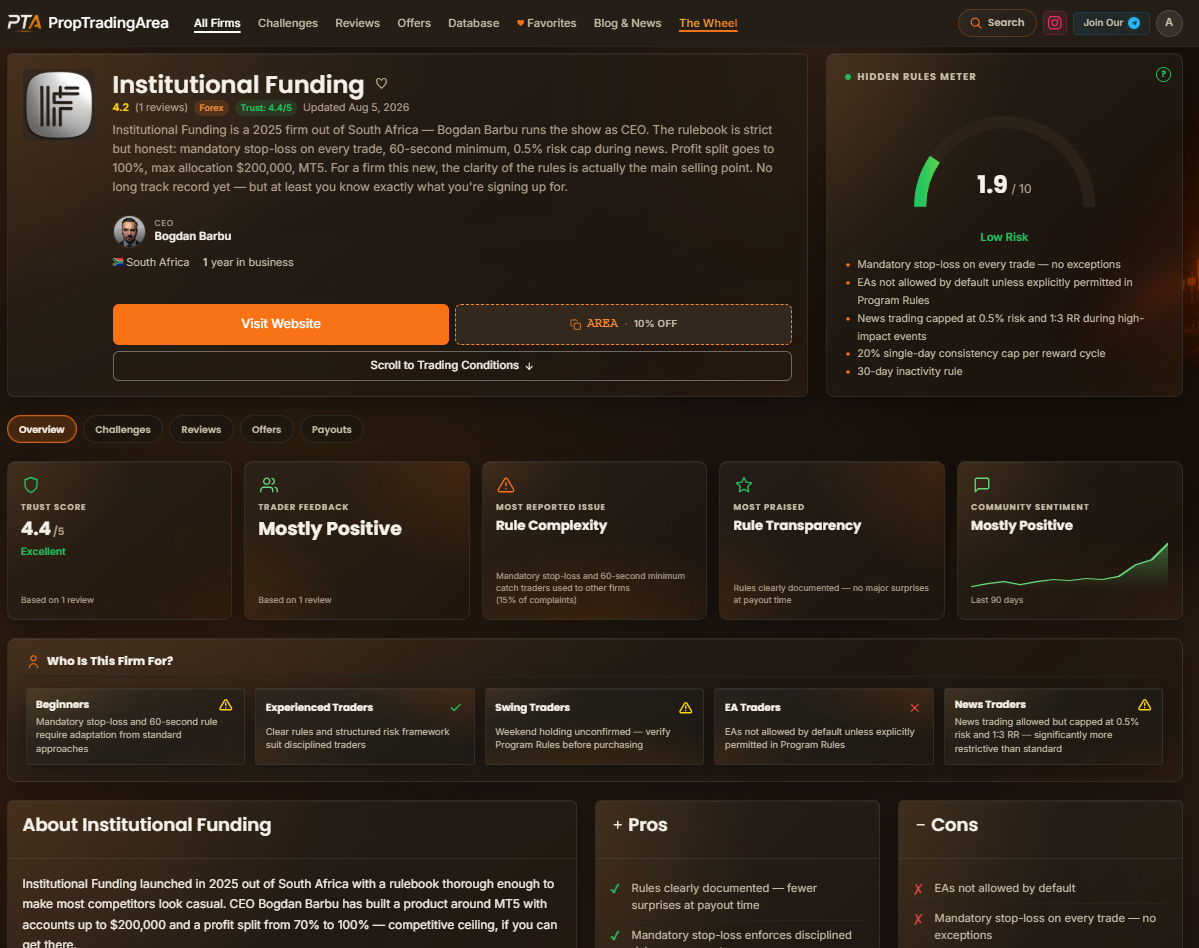
CEO Bogdan Barbu launched the firm in 2025 out of South Africa. No long community track record yet. But the terms are clearer than most firms twice its age, and for some traders that's worth something.
The Quick Verdict
Institutional Funding is a 2025 prop firm with a thoroughly documented ruleset, MT5 platform, $200K max allocation, and a profit split that goes to 100%. The mandatory stop-loss, 60-second minimum trade duration, and 0.5% news risk cap are stricter than the industry standard. Payouts are discretionary until approved. No long track record to evaluate — start small, verify the process, then scale.
Who Institutional Funding Is
Institutional Funding operates as Institutional Edge Ltd., registered in the British Virgin Islands with operational leadership based in South Africa. CEO Bogdan Barbu founded the firm in 2025 — making it one of the newer firms on PropTradingArea's list.
The firm offers simulated trading evaluation programs with performance-based rewards, running exclusively on MT5. Account sizes reach up to $200,000 with a profit split ranging from 70% to 100%. Payment settlement runs through Odeonpay ALE S.R.L. (Paysagi) as Merchant of Record — worth knowing for KYC and payment processing purposes.
What Institutional Funding doesn't have yet is a multi-year community track record. The T&C is clear. The payout process hasn't been tested at scale. That's the honest starting point for any evaluation of this firm. For a broader view of the prop firm landscape, our Best Prop Trading Firms 2026 guide covers the full ranking.
The Rules That Stand Out
Most prop firm terms and conditions cover the same ground with minor variations. Institutional Funding's do the same — with three specific conditions that are stricter than the industry standard and worth understanding before your first trade.
Mandatory stop-loss on every trade. A stop-loss must be placed immediately upon opening any position. No exceptions, no grace period. Trading without a stop-loss is a rule violation from trade one. If your strategy involves discretionary stop placement after entry, or risk management through position sizing rather than fixed stops, you need to adapt before you start.
60-second minimum trade duration. Any trade closed in under 60 seconds is a tick scalping violation. Most competitors set this at 30 seconds. One violation won't close your account — a pattern of them will. If you occasionally close trades quickly on momentum, start tracking your hold times before you apply.
News trading capped at 0.5% risk and 1:3 RR. News trading is allowed — but during high-impact events, your maximum risk per trade drops from the standard 1.5% to 0.5%, and the reward-to-risk ceiling is set at 1:3. News straddling is explicitly prohibited. For traders who size up on announcements, the cap limits how much you can make from the setups you were most looking forward to. For our full breakdown of how hidden rules like these affect traders, see the Prop Firm Hidden Rules Complete Guide.
Standard Conditions
Outside those three, Institutional Funding's trading rules are broadly industry-standard:
▪ Maximum 1.5% risk per trade (entry to stop-loss at execution)
▪ Maximum Relative Drawdown — trailing from highest equity, breached immediately if equity falls below threshold
▪ 20% daily consistency cap — no single day can represent more than 20% of total profit in the Performance Reward Cycle
▪ Minimum 5 trades per reward cycle
▪ 30-day inactivity rule — no trades in 30 consecutive calendar days triggers account review or closure
▪ 12-month maximum program duration from account activation
▪ One position per instrument at a time
▪ EAs not allowed by default — only permitted if explicitly enabled in specific Program Rules
▪ No external signals, no coordinated group trading, no multi-accounting
Payouts
Performance Rewards at Institutional Funding are explicitly described as discretionary — eligibility does not create a legal entitlement until the reward has been reviewed, approved, and authorized by the Company. That's standard industry language and not unique to this firm, but it's worth stating plainly for a 2025 operation with no established payout track record to point to.
Profit split runs from 70% at entry to 100% at the performance ceiling. The path to 100% depends on Program Rules specific to each account type — confirm the exact milestones before you start. Check current challenge pricing and offers →
Who Institutional Funding Is For
▪ Disciplined manual traders who already use stop-losses on every trade and hold positions for at least a minute — the mandatory rules won't change anything
▪ Experienced traders who want a clearly documented rule framework with no ambiguity about what's permitted
▪ Traders who are comfortable being early adopters of a new firm in exchange for competitive split potential
Who Institutional Funding Is Not For
▪ EA traders — not permitted by default
▪ Scalpers who close trades in under 60 seconds
▪ News traders who rely on large position sizing during announcements — the 0.5% cap significantly limits returns from high-volatility setups
▪ Traders who need a multi-year payout track record before committing capital
Final Verdict
Institutional Funding is a 2025 firm with a strict but honest rulebook. The mandatory stop-loss, 60-second minimum, and news risk cap are real constraints that require real adaptation — but they're documented clearly enough that nothing should surprise you at payout time. That clarity is genuinely more than some established firms manage.
No long track record yet. No community data to cross-reference against the terms. The right approach is the same as with any new firm: start with the smallest account size that lets you verify the payout process, then decide whether to scale. The terms give you no excuse for being caught off guard. The rest is up to the track record they build from here.