Prop Firm Hidden Rules — The Complete Guide
Well... if you've ever failed a prop firm challenge and spent twenty minutes re-reading the rules trying to figure out what you did wrong, this article is for you. Not because you definitely broke a rule — but because there's a reasonable chance the rule that got you wasn't the one you thought you were following. It was a different one. One that was technically in the terms and conditions. Just not in the FAQ, not in the onboarding email, and not mentioned anywhere near the profit target and drawdown limits they used to sell you the challenge.
That's what we mean by hidden rules. Not rules that are literally secret — prop firms publish their terms, technically — but rules that are structurally obscured: buried in subsections, written in language that sounds like standard legal boilerplate, or omitted entirely from the summary pages most traders actually read. The result is the same either way: traders fail challenges for reasons they didn't see coming, and firms collect another reset fee.
This guide covers every major category of hidden rule we've identified across 36+ firms, with real examples, how to spot them before you pay, and what the data actually shows about which firms use them most aggressively.
What Makes a Rule "Hidden"?
A hidden rule isn't necessarily one that never appears in the written terms. It's one that fails the reasonable trader test: would a trader who read the pricing page and FAQ know this rule exists before it affected their account? If the answer is no, it's a hidden rule regardless of whether it's technically documented somewhere on page 8 of a 12-page terms and conditions PDF.
Hidden rules tend to cluster in a few categories. Some are genuinely obscure — consistency requirements, for example, often aren't mentioned anywhere near the profit target and drawdown limits they're designed to interact with. Others are hidden in plain sight — the non-disparagement clause that appears in section 23 of a terms document, three sections after traders have stopped reading. Others are hidden by omission: firms that don't mention their KYC interview requirement until you've already passed the challenge and are waiting for your first payout.
PropTradingArea scores every firm's terms on a 0-10 Hidden Rules Meter — 0 being completely transparent, 10 being actively working against the trader. The categories below are what that score is based on.
Category 1 — Consistency Rules
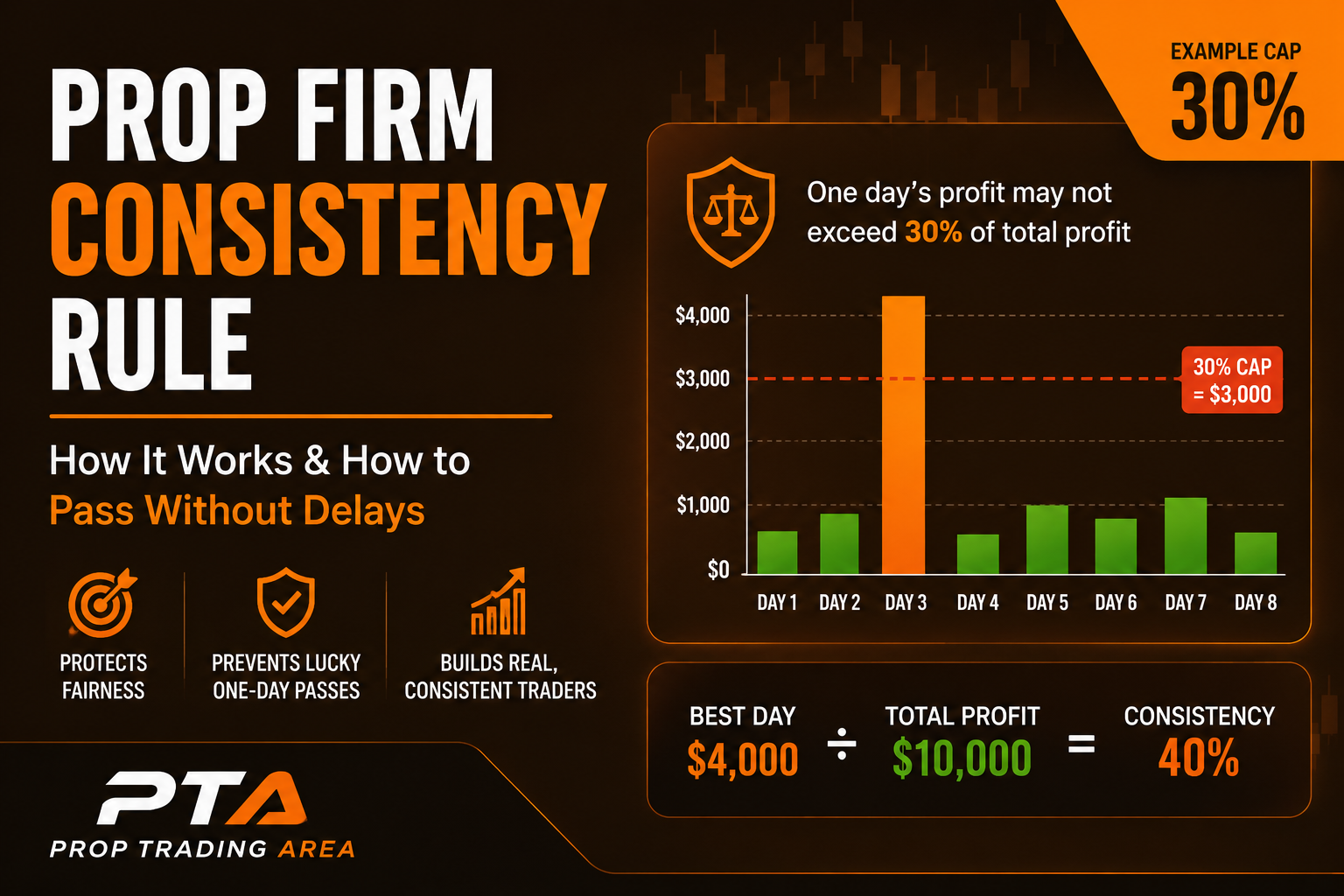
Consistency rules are the most common hidden rule in the industry, and arguably the most impactful. The basic version works like this: you pass the challenge, hit the profit target, stayed within drawdown — but one of your trading days was too good relative to your total profit, so your payout gets delayed, your results get flagged, or your account gets reviewed.
The most widely known version is the 30% best day rule, popularised by Funding Traders and several other firms: no single trading day can represent more than 30% of your total profit on a funded account. But consistency rules take many forms:
▪ Best day profit caps (typically 30-50% of total PnL)
▪ Minimum trading day requirements (you must trade on at least X days, not just hit the target fast)
▪ Maximum lot size relative to account balance — you can't size up aggressively on one trade even if you stay within drawdown
▪ News profit caps — profits from news trading can't exceed a certain percentage of total PnL
▪ Strategy consistency requirements — your approach must be "replicable" on a live account, as judged by the firm's risk team
Why are these hidden? Because firms typically present them as funded account rules, not challenge rules. Traders research the challenge parameters, pass the challenge following those parameters, and then get introduced to a different set of rules on the funded account. The consistency rule wasn't hidden from the challenge — it just wasn't relevant until it became relevant.
The practical implication: always read the funded account terms specifically, not just the challenge parameters. They're often documented on a different page.
Category 2 — News Trading Restrictions
News trading rules are disclosed more often than most hidden rules, but the details are where traders get caught. A firm that says "news trading allowed" can still fail your account for news trading — because "allowed" applies to a different account type than the one you're on, or because the profits from that news trade pushed you over a consistency cap, or because the trade was opened inside a blackout window you didn't know existed.
The most common version: a 2-5 minute window before and after high-impact news events during which trades on affected instruments can't be opened, closed, or modified. Some firms extend this to 10 minutes. Some apply it to all instruments, not just the one affected by the release. Some apply it only on funded accounts and not during the challenge.
What makes this genuinely dangerous for automated traders: an EA won't notice it's about to fire a trade 90 seconds before an NFP release unless you've specifically coded a news filter. The blackout window rules are often documented clearly — but in a separate section from the "news trading allowed" headline that most traders read and stop at.
The more aggressive version: firms that count any trade opened within X minutes of a news event as a "news trade," regardless of whether the trader intended to trade the news. This classification matters because news trade profits may be subject to separate PnL caps even when the trade would otherwise be fine.
Category 3 — Weekend and Overnight Holding Restrictions
Weekend holding is one of the cleaner hidden rules to identify — firms either allow it or they don't, and that's usually disclosed. The hidden part tends to be in the mechanics rather than the policy itself.
The most common version: positions auto-close before the weekend rollover, typically Friday afternoon. Hola Prime, for example, closes positions at 15:45 EST on Fridays. The weekend holding policy says "allowed" — technically true — but the account closes your positions anyway. Profits from forced closes count toward your payout. Losses from forced closes count against you.
The genuinely hidden version: firms that don't disclose the forced-close mechanism at all, leaving traders to discover it when their positions disappear at 5pm on a Friday.
Overnight holding restrictions are less common but exist at some firms — particularly on instant funding accounts where the risk model is tighter. These are rarely featured prominently on pricing pages.
Category 4 — Lot Size, Position, and Correlation Limits
This category covers the rules around how you can size positions, how many you can hold at once, and what happens when you hold correlated instruments simultaneously.
Standard position size limits — maximum lot per trade relative to account balance — are usually disclosed. The hidden versions are more subtle:
▪ Per-trade-idea caps that treat multiple same-direction entries as a single position for risk purposes (Hola Prime's 2% cap per trade idea is a clean example). Split entries around the same setup don't multiply your allowed risk — they share it.
▪ Correlation rules that restrict simultaneous positions on related instruments — EURUSD and GBPUSD both long, for example, may be treated as one directional bet rather than two separate trades.
▪ Strategy-level capital caps — FTMO's $400K limit per strategy means the same EA running on multiple accounts shares an allocation ceiling across all accounts combined.
▪ Martingale and grid restrictions — systems that increase position size after losses or set multiple orders at different price levels are explicitly banned at most firms, but the definition of what constitutes "martingale behavior" varies and isn't always clear.
Category 5 — EA and Automation Restrictions
The most obvious hidden rule in this category: firms that say "EAs allowed" when they mean "EAs allowed on some account types with pre-approval, except on instant accounts, and subject to review if the risk team decides your system looks unusual." FXIFY's EA pre-approval requirement is at least documented — the hidden version is firms that don't mention the review process until a payout gets flagged.
The subtler versions:
▪ Server request limits — FTMO's 2,000 server requests per day cap catches high-frequency systems that modify TP/SL levels frequently, not just true HFT. This is documented but rarely mentioned near the "EAs allowed" disclosure.
▪ Copy trading restrictions — many firms allow copy trading between your own accounts but prohibit copying from external accounts or third-party signal providers. The line between "copying your own verified strategy" and "copying a third-party signal" isn't always defined clearly.
▪ Commercial EA restrictions — some firms flag accounts running commercially available EAs if multiple traders appear to be using identical strategies. Your EA technically complies with all rules. Your account gets reviewed anyway.
Category 6 — Payout Conditions and KYC Traps
This is where the most impactful hidden rules live, because they operate at the moment of highest stakes: when you're waiting for money that you've already earned.
The most common version: KYC verification requirements that only appear after you've passed the challenge. You pass, you request a payout, and then you're informed that you need to complete identity verification — including, at some firms, a video interview — before the payout can be processed. The verification process takes 48-72 hours. The interview is mandatory. And if you fail the interview, the account application is rejected and fees are non-refundable.
This is disclosed in the terms. But it appears in the data security section of those terms, not in the payout section, and not anywhere near the challenge parameters that traders focus on when evaluating a firm.
Other payout conditions worth knowing:
▪ Name matching requirements — the name on your account must match your KYC documents exactly, and at some firms (Hola Prime is explicit about this), the name field is locked at registration and cannot be corrected afterward. A typo at signup becomes a KYC failure months later.
▪ Minimum holding periods before the first payout — typically 14-30 days of active trading after reaching funded status. Not always disclosed near the "fast payouts" marketing.
▪ Payout denial for rule violations that occurred during the challenge, not the funded stage — some firms reserve the right to review challenge trading history during the payout verification process and deny payouts based on what they find there.
▪ Withholding payouts during ongoing reviews — triggered by flags like high risk-per-trade or inconsistent strategy, payouts can be paused indefinitely while the review is active.
Category 7 — Non-Disparagement and Communication Clauses
This category has become more common since 2023, and it's worth knowing about before you sign anything. A non-disparagement clause requires traders to agree not to make negative public statements about the firm — on social media, in reviews, in public forums — for the duration of the agreement and often beyond it.
The most aggressive versions (Hola Prime's Section 23 is an example we've reviewed in detail) include:
▪ The firm determines unilaterally whether the clause has been breached — and that determination is "final and binding" for purposes of account suspension
▪ The trader agrees to pay all of the firm's legal costs if any dispute arises, regardless of outcome
▪ Support communications cannot be shared publicly without written consent
▪ The clause survives termination of the agreement — meaning it applies after you've left the platform
These clauses are legal in most jurisdictions, though their enforceability varies. What they do in practice is create a chilling effect: traders who have legitimate complaints about delayed payouts or unfair account terminations are less likely to post publicly about it, which makes the firm's Trustpilot profile look cleaner than the underlying experience might justify.
The practical implication for traders: read Section 23, or whatever section covers "non-disparagement," before you sign. It's usually near the end of the terms, well past the point where most traders have stopped reading.
Category 8 — Risk Team Discretion Clauses
The final category is the broadest and the hardest to protect against: clauses that give the firm's risk team the authority to take action — including account termination and payout denial — based on their own assessment of whether your trading is in the spirit of the rules, regardless of whether any specific rule was technically broken.
Every major prop firm has some version of this clause. The hidden rule isn't that it exists — it's in how broadly it's written and how aggressively it's applied. The difference between "we reserve the right to review unusual trading activity" and "we reserve the right to terminate any account at our sole discretion without specifying a reason" is significant, but both appear in terms and conditions across the industry.
The red flags to look for:
▪ "Sole and absolute discretion" — no appeal process, no stated criteria
▪ "Spirit of the rules" language without any definition of what that means
▪ Discretion clauses that survive payout — the firm can withhold already-earned profits while a review is ongoing
▪ No stated timeframe for how long a review can last
How to Spot Hidden Rules Before You Pay
The honest answer: you have to read the full terms and conditions, not just the FAQ. But here's a faster checklist for identifying the highest-risk clauses without spending two hours on every firm's legal pages:
▪ Search the terms for "consistency" — if that word appears, read every paragraph it's in. Consistency rules are almost never disclosed on pricing pages.
▪ Search for "sole discretion" — tells you how much unilateral authority the firm's risk team has
▪ Search for "disparagement" or "non-disparagement" — tells you what you're agreeing to regarding public statements
▪ Search for "KYC" and read what it says about timing — before challenge, after challenge, or before first payout are meaningfully different
▪ Read the funded account rules separately from the challenge rules — they are different documents at most firms
▪ Check whether "news trading allowed" applies to your specific account type — not just to some account types the firm offers
The PropTradingArea Hidden Rules Meter does this systematically for every firm we list — scoring each firm's terms on a 0-10 scale based on the categories above. A score of 0-2 means the rules are clean and straightforward. A score of 5-7 means there are meaningful clauses worth reading carefully. A score above 7 means the firm's rules are structured in ways that are actively working against the trader even within technically legal parameters.
Firms With the Lowest Hidden Rules Scores
These are the firms where we've found the cleanest, most transparent terms across the categories above. Low scores mean fewer surprises at payout time, not that the challenges are easy.
| Firm | Market | Hidden Rules Score | Risk Label |
|---|---|---|---|
| FXIFY Futures | Futures | 1.3 | Very Low |
| Funding Traders | Forex | 1.9 | Low |
| The5ers | Forex | 1.7 | Low |
| Funding Pips | Forex | 1.8 | Low |
| Earn2Trade | Futures | 2.0 | Low |
| Elite Futures | Futures | 2.1 | Low |
| Funding Traders | Forex | 2.2 | Low |
| Funded Trading Plus | Forex | 2.6 | Low |
Firms With the Highest Hidden Rules Scores
These firms have terms that score higher on our meter — meaning more clauses in the categories above, written more broadly, or applied more aggressively based on community feedback. Higher scores don't mean a firm is a scam. They mean the terms deserve extra attention before you commit.
| Firm | Market | Hidden Rules Score | Risk Label |
|---|---|---|---|
| Finotive Funding | Forex | 7.1 | High Risk |
| GOAT Funded Trader | Forex | 5.9 | High Risk |
| GOAT Funded Futures | Futures | 5.9 | High Risk |
| Blueberry Funded | Forex | 5.1 | High Risk |
| Blueberry Futures | Futures | 6.2 | High Risk |
| Maven Trading | Forex | 3.5 | Moderate |
| Atmos Funded | Forex | 3.5 | Moderate |
How PropTradingArea Calculates the Hidden Rules Score
The Hidden Rules Meter score is calculated by our team reading the full terms and conditions for every firm we list — not just the FAQ, not just the pricing page, but the complete legal documentation including funded account rules, prohibited trading practices, and any supplementary documents linked from the main terms.
We score each firm across the categories in this guide: consistency rules, news trading restrictions, payout conditions, KYC requirements, discretion clauses, non-disparagement provisions, and anything else we find that a reasonable trader wouldn't expect based on the firm's marketing materials. Each category is weighted by how impactful it is at the moment it matters most — payout time.
The score is updated when firms change their terms, when community feedback suggests a discrepancy between published rules and actual enforcement, and when our Trustpilot Analyzer picks up patterns in one-star reviews that point to specific rule categories being applied unexpectedly. The score is never influenced by commercial relationships with any firm — no firm pays to have their score changed, and several firms with affiliate relationships appear in the high-score table above.
Full methodology is published in our How We Calculate Prop Firm Pass Rates article, which covers both the pass rate and hidden rules methodology in detail.
Final Verdict
idk man — the prop firm industry isn't uniquely dishonest. Most of these rules are in the terms. The problem is that the terms are structured to be skimmed rather than read, and the rules that matter most tend to appear in the sections traders are least likely to reach.
The firms that score well on the Hidden Rules Meter aren't necessarily easier or more generous — they're just more honest about what the rules are upfront. That's a lower bar than it sounds, but it's not zero firms that clear it.
Use the scores and the category guide above before you pay for your next challenge. The twenty minutes you spend reading the funded account terms is worth more than whatever discount code brought you to the pricing page.
Every firm mentioned in this article has a full profile on PropTradingArea with the complete trading conditions breakdown, community snapshot, and Hidden Rules Meter notes — linked in the tables above and updated regularly as our data comes in.