Futures vs Forex/CFD Prop Trading — Which One Is Actually Right For You?
Choosing between futures and forex/CFD prop trading is a bit like choosing between a manual and an automatic car. Both get you from A to B. One gives you more control. The other is easier to stall. And neither will help you if you don't know where you're going.
This article covers everything you need to make an informed decision: how the two markets actually work, what the key differences are in contracts, lot sizes, pricing, drawdown mechanics, and which prop firms operate in each space. We'll use real data from our platform — pass rates, hidden rules scores, and pricing — so you're not making the decision based on marketing copy.
Let's start with the basics.
What Are You Actually Trading?
Forex / CFD
In forex and CFD prop trading, you're trading contracts for difference — a financial instrument that tracks the price of an underlying asset without you actually owning it. You open a buy or sell position on EUR/USD, Gold, or the S&P 500 index, and your profit or loss is the difference between entry and exit price, multiplied by your position size.
The key word is simulated. Most prop firm CFD accounts are demo environments using real market data. You're not placing orders on an actual exchange. The firm is evaluating your ability to trade profitably under specific risk parameters — not routing your orders to a broker in real time.
Futures
Futures are standardized exchange-traded contracts that obligate the buyer to purchase (or the seller to sell) a specific asset at a predetermined price on a specific future date. Unlike CFDs, futures trade on regulated exchanges — the CME (Chicago Mercantile Exchange) being the primary one for US futures prop trading.
When you trade the ES (E-mini S&P 500), NQ (E-mini Nasdaq), CL (Crude Oil), or GC (Gold) futures contract, you're trading a real instrument on a real exchange with real market participants. The prop firm's evaluation environment uses simulated capital — but the price data is live exchange data, and the mechanics mirror actual futures trading exactly.
This distinction matters. Futures have fixed contract specifications — lot sizes, tick values, margin requirements — that don't change based on what leverage a broker decides to offer. In CFD trading, position sizing is more flexible and more confusing. In futures, it's standardized and unambiguous.
Lot Sizes vs Contracts — The Most Confusing Part
This is where most traders coming from forex get lost when they look at a futures prop firm for the first time. So let's make it simple.
Forex/CFD: Lots
In forex CFD trading, position size is measured in lots:
| Lot Type | Units | Typical Pip Value (EUR/USD) |
|---|---|---|
| Standard Lot | 100,000 units | ~$10 per pip |
| Mini Lot | 10,000 units | ~$1 per pip |
| Micro Lot | 1,000 units | ~$0.10 per pip |
Leverage in CFD trading is typically 1:10 to 1:100 depending on the prop firm. This means on a $100K account with 1:100 leverage, you can control $10,000,000 in notional value. That sounds impressive until you realize it also means a 1% move against you wipes the account.
Futures: Contracts (Mini & Micro)
In futures trading, position size is measured in contracts. Each contract has a fixed notional value defined by the exchange — not by the broker, not by the prop firm. You can't negotiate it.
| Contract | Instrument | Tick Size | Tick Value | Notional Value (approx) |
|---|---|---|---|---|
| ES (E-mini S&P) | S&P 500 | 0.25 points | $12.50 | ~$250,000 |
| MES (Micro E-mini S&P) | S&P 500 | 0.25 points | $1.25 | ~$25,000 |
| NQ (E-mini Nasdaq) | Nasdaq 100 | 0.25 points | $5.00 | ~$400,000 |
| MNQ (Micro E-mini Nasdaq) | Nasdaq 100 | 0.25 points | $0.50 | ~$40,000 |
| CL (Crude Oil) | WTI Crude | $0.01 | $10.00 | ~$70,000 |
| GC (Gold) | Gold | $0.10 | $10.00 | ~$200,000 |
The Mini contracts (ES, NQ, CL, GC) are the standard size for professional futures traders. The Micro contracts (MES, MNQ) are exactly 1/10th the size — designed for smaller accounts and risk management.
When a futures prop firm says "maximum 3 Mini contracts / 30 Micro contracts," they mean you can hold up to 3 ES or 30 MES contracts simultaneously. These are not interchangeable — 1 Mini ≠ 10 Micro in terms of exchange margin requirements, but they carry the same dollar P&L per tick ratio.
The Practical Difference
In CFD trading, you can size down to micro lots and trade with extreme precision. In futures, your minimum position is 1 Micro contract — which on the ES means each 0.25-point tick is worth $1.25. That's small, but it's not infinitely divisible the way CFD position sizing can be.
For traders coming from forex who are used to risking $5 on a trade, the transition to futures requires recalibrating position sizing entirely. The instruments are bigger, the tick values are fixed, and the margin requirements are exchange-mandated rather than broker-defined.
Drawdown Mechanics — EOD vs Trailing vs Static
This is where futures and CFD prop firms diverge significantly — not because one market requires different rules, but because different firms have made different product choices.
Static Drawdown (most common in CFD)
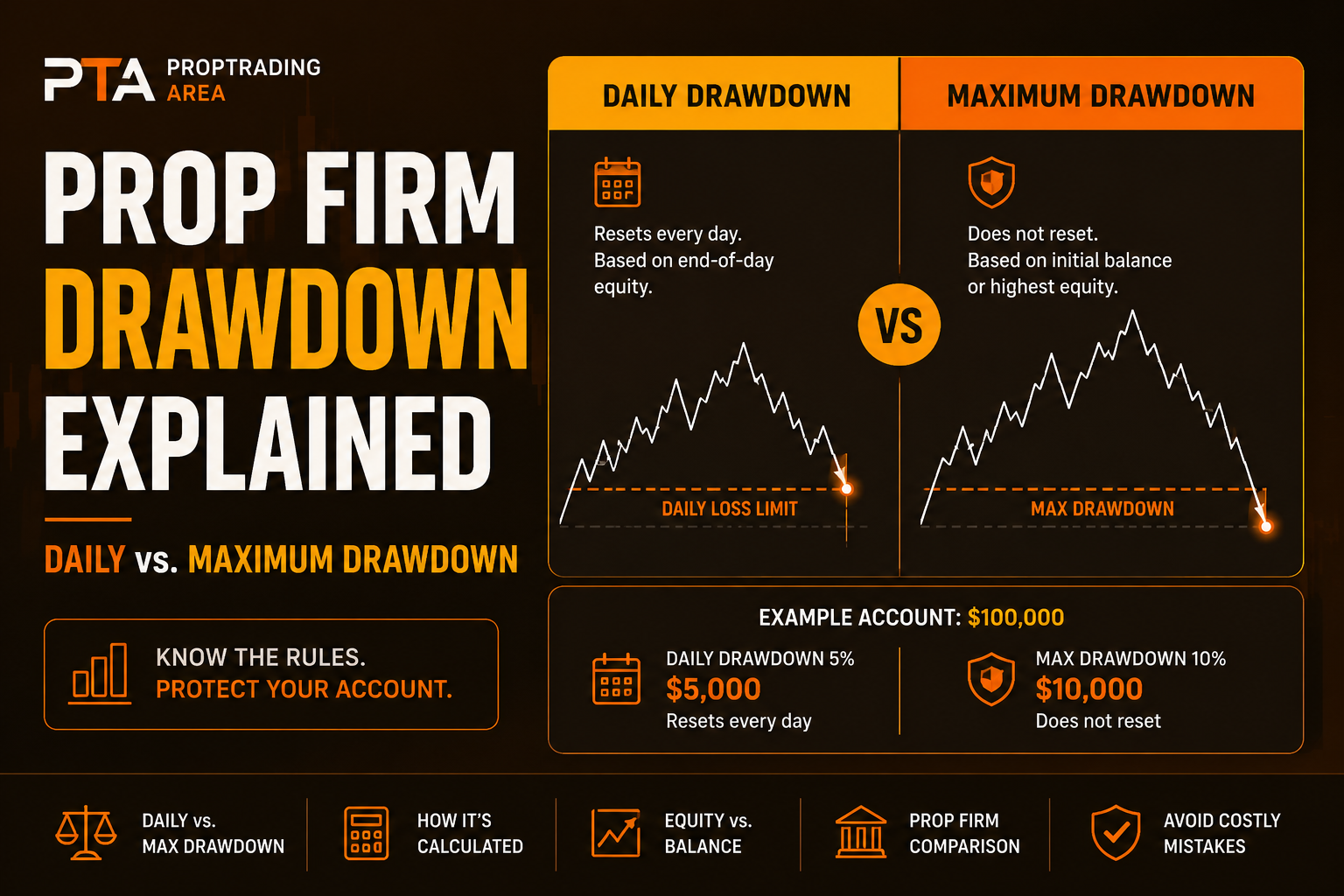
Your max drawdown is calculated from your initial balance. It never moves. On a $100K account with 10% static drawdown, your floor is always $90,000 — regardless of how much profit you make. FTMO's 2-Step Challenge uses static drawdown. Funding Pips uses static drawdown. Most CFD-focused firms use static drawdown because it's simple to understand and plan around.
Trailing Drawdown (common in futures)
Your max drawdown follows your highest equity point. If you start at $100K with a $3K trailing drawdown and grow to $104K, your floor moves up to $101K. If you then drop back to $101K, you're at the limit — even though you're still $1K above your starting balance.
Trailing drawdown rewards consistent growth and penalises giving back profits. It's the standard in futures prop trading because it mirrors how real futures traders manage risk — protecting gains, not just protecting starting capital.
EOD Drawdown (End of Day — futures specific)
Your drawdown is measured at the end of each trading session, not in real time. Intraday swings — even large ones — don't count as long as you recover before the session closes. This is the most forgiving drawdown structure for volatile strategies. Blue Guardian Futures uses EOD drawdown across all evaluation models. FXIFY Futures uses trailing on Standard and Expert. Earn2Trade uses EOD on Gauntlet Mini.
The EOD structure is one of the primary reasons experienced intraday futures traders prefer it over trailing drawdown. A 2-point adverse move on ES during a news event that recovers 30 minutes later doesn't breach anything under EOD rules. Under trailing drawdown, that move permanently raises your floor.
Pass Rates — What the Data Actually Shows
Here's where it gets interesting. Using our platform's data across all 36 firms, here's how futures and CFD/forex prop firms compare on overall pass rates:
Futures Prop Firms
| Firm | Pass Rate | Hidden Rules Meter | Max Allocation |
|---|---|---|---|
| FXIFY Futures | 31.8% | 1.3/10 — Very Low Risk | $400,000 |
| Earn2Trade | 31.1% | 2.0/10 — Low Risk | $400,000 |
| Elite Futures (FuturesElite) | 26.7% | 2.1/10 — Low Risk | $1,500,000 |
| Blue Guardian Futures | 22.3% | 2.4/10 — Low Risk | $400,000 |
| Aqua Futures | 21.7% | 3.1/10 — Moderate Risk | $150,000 |
| GOAT Funded Futures | 6.1% | 5.9/10 — High Risk | $150,000 |
| Blueberry Futures | 6.1% | 6.2/10 — High Risk | $150,000 |
Top CFD/Forex Prop Firms
| Firm | Pass Rate | Hidden Rules Meter | Max Allocation |
|---|---|---|---|
| FTMO | 31.3% | 1.4/10 — Low Risk | $400,000 |
| E8 Markets | 30.3% | 1.6/10 — Low Risk | $150,000 |
| FXIFY | 30.1% | 1.7/10 — Very Low Risk | $400,000 |
| Funding Pips | 27.4% | 1.8/10 — Low Risk | $200,000 |
| The5ers | 24.3% | 1.7/10 — Low Risk | $4,000,000 |
| Funded Next | 21.3% | 2.3/10 — Low Risk | $300,000 |
The industry average pass rate across all 36 firms on our platform is ~20%. The top futures firms — FXIFY Futures at 31.8% and Earn2Trade at 31.1% — match the top CFD firms on pass probability. The bottom futures firms — GOAT Funded Futures and Blueberry Futures at 6.1% — are significantly below average.
The takeaway: the market you choose matters less than the firm you choose. A well-run futures prop firm produces the same pass rates as a well-run CFD firm. A poorly-run firm in either category produces significantly worse outcomes.
Pricing — What Does a Challenge Actually Cost?
CFD/Forex Challenge Pricing
Most CFD prop firms charge a one-time fee for evaluation challenges. Prices are generally based on account size:
| Firm | $10K Account | $50K Account | $100K Account | Model |
|---|---|---|---|---|
| FTMO | $89 | $345 | $540 | 2-Step |
| FXIFY | $59 | $249 | $399 | 2-Step |
| Funding Pips | $48 | $188 | $358 | 2-Step |
| Funded Next | $49 | $199 | $349 | 2-Step |
Futures Challenge Pricing
Futures prop firms generally don't offer $10K accounts — the minimum meaningful futures account starts at $25K-$50K due to exchange margin requirements. Pricing models also differ: some use monthly subscriptions, others one-time fees.
| Firm | $25K Account | $50K Account | $100K Account | Fee Model |
|---|---|---|---|---|
| FXIFY Futures | N/A | From $149 | From $249 | One-time |
| Earn2Trade | N/A | $150/mo | $250/mo | Monthly subscription |
| Elite Futures | N/A | From $79/mo | From $151/mo | Monthly subscription |
| Blue Guardian Futures | $39 (Guardian) | From $85/mo | From $129/mo | Monthly / One-time |
| Aqua Futures | $50 | $65 | $125 | One-time |
The monthly subscription model at futures firms deserves specific attention. At Earn2Trade, you pay $150/month until you pass — or until you cancel. A trader who takes three months to pass a $50K Gauntlet Mini has paid $450 total. A trader who takes six months has paid $900. The subscription model rewards fast passers and punishes slow ones in a way that one-time fees don't.
Firms That Do Both — Futures AND Forex/CFD
Several firms on our platform offer both futures and CFD products — sometimes under the same account structure, sometimes as separate products entirely.
| Firm | Futures | Forex/CFD | Notes |
|---|---|---|---|
| The5ers | ✅ | ✅ | Futures integrated into standard account structure |
| Funded Next | ✅ | ✅ | Futures available alongside CFD models |
| E8 Markets | ✅ | ✅ | E8 Futures as a separate product line |
| For Traders | ✅ | ✅ | Futures, Forex, Indices, Metals all available |
For traders who want to test both markets without committing to a futures-only or CFD-only firm, The5ers and For Traders are the most flexible options — both offer futures instruments within their standard evaluation structure without requiring a separate account.
Key Rule Differences — What Changes Between Markets
News Trading
In CFD prop trading, news restrictions typically mean a 2-5 minute window around high-impact events where positions cannot be opened or closed. Profits from trades within the window are voided.
In futures prop trading, the restrictions are similar in principle but different in mechanics. Because futures are exchange-traded and slippage is real, firms are particularly sensitive to strategies that exploit news-driven volatility. FXIFY Futures restricts news trading on Lightning and Instant models. Earn2Trade restricts bracketing data releases. Blue Guardian Futures prohibits the boom-or-bust approach without a specific time window.
Scalping
Most CFD firms define scalping restrictions by minimum hold time — trades under 2 minutes generating more than 30% of profits, or similar metrics. Elite Futures (FuturesElite) disables scalping across all models entirely. Most other futures firms restrict HFT and high-frequency execution without banning scalping as a category.
EA Trading
CFD firms generally allow EAs — FTMO, FXIFY, Funding Pips all permit automated trading with specific restrictions around HFT and arbitrage. Futures firms are more divided. FXIFY Futures prohibits EAs entirely across all models. Elite Futures prohibits scalping-based EAs specifically. Blue Guardian Futures and Aqua Futures don't explicitly ban EAs but apply the strategy consistency rule.
Contract Limits
CFD accounts don't have fixed contract limits in the same way — position sizing is governed by lot limits relative to account size and leverage. Futures accounts have hard contract limits per account size that are set by the prop firm and cannot be exceeded. On a $50K FXIFY Futures Standard account, you can hold a maximum of 3 Standard contracts and 30 Micro contracts simultaneously. Full stop. No exceptions.
Trading Platforms — What You Actually Use
The platform difference between futures and CFD trading is significant — and often overlooked by traders who assume everything runs on MetaTrader.
CFD/Forex: MetaTrader Dominates
The overwhelming majority of CFD prop firms use MetaTrader 4 or MetaTrader 5 as their primary platform. MT4 has been the industry standard for retail forex since 2005. MT5 is its successor with more asset classes and more order types. Both are free, widely available, and run on Windows, Mac, and mobile.
The advantage of MT4/MT5 is ubiquity — virtually every CFD broker and prop firm supports it, the interface is standardized, and the EA ecosystem is enormous. The disadvantage is that it was built for retail forex trading, not for professional futures execution. For index and commodity futures trading, it's a workaround, not a native solution.
Other CFD platforms used by prop firms include DXtrade (used by FTMO, Funding Pips), TradeLocker (used by several newer firms), and cTrader. All are broadly comparable for CFD trading.
Futures: Purpose-Built Platforms
Futures prop trading uses platforms built specifically for futures execution on CME and other exchanges. The primary ones you'll encounter:
| Platform | Best For | Prop Firms Using It |
|---|---|---|
| Tradovate | Cloud-based, clean interface, good for beginners | FXIFY Futures, Blue Guardian Futures, Aqua Futures, GOAT Funded Futures |
| NinjaTrader | Advanced charting, strategy automation, professional traders | FXIFY Futures, Earn2Trade, Elite Futures, Blue Guardian Futures |
| Quantower | Multi-asset, advanced order flow tools | Elite Futures |
| ATAS | Order flow analysis, footprint charts, institutional-grade tools | Elite Futures, GOAT Funded Futures |
| Volumetrica | Volume profile, market depth, European traders | Elite Futures, GOAT Funded Futures |
| DeepCharts / DeepMap | dxFeed data, modern interface | Blueberry Futures, GOAT Funded Futures |
The platform you use matters more in futures than in CFD trading — because order execution speed, order flow visualization, and depth of market data are more critical when you're trading exchange-based instruments with real tick data. A trader who uses ATAS for footprint chart analysis has a fundamentally different trading approach than one using basic bar charts on Tradovate. Both are valid. The platform choice is part of the strategy choice.
If you're coming from MT4/MT5 and considering futures, expect a learning curve. Tradovate is the most accessible transition. NinjaTrader is the most powerful but has the steepest learning curve. ATAS is the professional choice for order flow traders.
Real Trade Example — ES Futures vs SPX500 CFD
Numbers are easier to understand than concepts. Here's the same trade in both markets.
Scenario: You want to go long on the S&P 500. You believe it will move 10 points in your favour. You're risking $500 on the trade.
CFD Version — SPX500 on MT5
On a $50K CFD account with 1:100 leverage, 1 standard lot of SPX500 is worth approximately $50 per point. To risk $500 on a 10-point move, you trade 1 lot with a 10-point stop loss.
- Position: 1 lot SPX500
- Stop loss: 10 points = $500 risk
- Target: 10 points = $500 profit (1:1 R/R)
- Typical spread: 0.4-1.0 points depending on broker
- Commission: $0-$5 depending on firm
The spread cost on a round trip at 1 point = approximately $50 per standard lot — meaning your actual risk/reward is slightly worse than the raw numbers suggest.
Futures Version — ES on Tradovate
On a $50K futures account, 1 MES (Micro E-mini S&P) contract has a tick value of $1.25 per 0.25-point tick — or $5 per full point. To risk $500 on a 10-point move, you trade 10 MES contracts.
- Position: 10 MES contracts
- Stop loss: 10 points = $500 risk ($5 per point × 10 contracts)
- Target: 10 points = $500 profit
- Commission: approximately $0.25-$0.50 per contract per side = $5-$10 round trip
- No spread — futures trade at the exchange bid/ask with no broker markup
The key difference: futures have no spread markup. You pay commission per contract, but the price you see is the price you get — it's the actual exchange order book. CFD trading adds a spread on top of the market price, which is how CFD brokers (and some prop firms) generate revenue.
For high-frequency or high-volume traders, the commission structure of futures is often cheaper than the spread structure of CFDs at equivalent position sizes. For lower-frequency traders with larger stops, the difference is negligible.
The Psychology of Each Market
This sounds like a soft section. It isn't.
Futures Traders Think in Contracts and Ticks
A futures trader thinks about risk in terms of ticks and contracts. "I'm risking 8 ticks on 2 MES contracts" = $20 risk. The math is fixed and unambiguous. You can't accidentally over-leverage because the contract size is non-negotiable.
This forces a specific type of discipline: you size up by adding contracts, which requires conscious decision-making. You can't gradually increase position size by adjusting a lot slider — you have to explicitly go from 2 contracts to 3. That friction is often cited by experienced futures traders as a psychological advantage over CFD trading.
CFD/Forex Traders Think in Pips and Percentages
A CFD trader thinks about risk in terms of percentage of account. "I'm risking 1% on this trade" = $500 on a $50K account. The position size calculation follows from the stop loss distance and the pip value — and it's different for every instrument and every trade.
The flexibility of CFD position sizing is a double-edged sword. The same slider that lets you risk exactly 0.73% on a trade also lets you accidentally risk 7.3% if you misplace a decimal. In futures, that particular category of error doesn't exist — contracts are integers.
Which Psychology Works Better?
Neither. The discipline required to trade profitably is the same in both markets. The mechanics of how you express that discipline differ. Futures traders tend to be more process-oriented around execution. CFD traders tend to be more flexible around position sizing. Both approaches produce profitable traders and losing traders in roughly equal measure — as the pass rate data confirms.
What the pass rate data does confirm: firms with clear rules, transparent T&Cs, and well-defined drawdown mechanics produce better outcomes regardless of market. FXIFY Futures at 31.8% and FTMO at 31.3% aren't coincidentally similar — they're both the product of well-structured evaluations with clearly communicated rules.
Which One Is Right For You?
Choose Futures If:
▪ You trade US indices (S&P 500, Nasdaq, Russell) — ES and NQ are the most liquid futures instruments in the world and the natural home for index traders
▪ You want exchange-regulated pricing with no broker manipulation risk
▪ You prefer EOD drawdown mechanics that don't penalise intraday volatility
▪ You're based in the US — futures prop firms are more accessible to US traders than most CFD firms
▪ You trade crude oil or gold with meaningful position sizes — CL and GC futures have significantly better liquidity than their CFD equivalents
Choose Forex/CFD If:
▪ You trade currency pairs — the EUR/USD, GBP/USD, and USD/JPY CFD markets are more accessible and cheaper to trade than FX futures equivalents
▪ You want micro lot position sizing below the minimum Micro futures contract
▪ You want access to individual stocks, crypto, and broader asset classes beyond what CME futures cover
▪ You're starting with smaller account sizes — $10K-$25K challenge accounts exist in CFD, not in futures
▪ You use an EA — CFD firms have broader EA policies than most futures firms
The Honest Summary
Futures and forex/CFD prop trading are different enough that the choice matters — but not so different that one is categorically better than the other. The pass rates at the top firms in each category are comparable. The hidden rules scores at the best firms in each category are comparable. The pricing, adjusted for account size and model, is comparable.
What's not comparable is the instrument mechanics. Futures have fixed contract specifications, exchange-regulated pricing, and EOD drawdown structures that suit intraday volatility. CFD accounts have more flexible position sizing, broader asset access, and lower minimum account sizes.
The platform difference is real — if you're a footprint chart trader using ATAS or an order flow trader on Volumetrica, futures is your natural home. If you're a forex scalper on MT4 with a system that's been running for three years, rebuilding it for futures makes no sense.
The cost difference is real but often misunderstood. Futures commissions per contract are fixed and transparent. CFD spreads are variable and depend on the broker behind the prop firm. For high-frequency traders at significant size, futures are typically cheaper. For occasional traders with wide stops, the difference is minimal.
The regulation difference is real and matters most for US-based traders. Futures trade on regulated exchanges under CFTC oversight. CFDs are largely unregulated for US retail traders, which is why most CFD prop firms don't accept US clients. If you're in the US, futures is the path of least resistance.
The final decision comes down to three questions:
▪ What instrument do you actually want to trade? If it's EUR/USD or individual stocks, CFD. If it's ES, NQ, CL, or GC, futures.
▪ What account size are you starting with? Under $25K challenge budget, CFD has more options. Above $25K, both markets have comparable offerings.
▪ What's your Hidden Rules tolerance? Look at our platform data. Pick the firm with the lowest Hidden Rules Meter score in whichever market you choose. That single number tells you more about your likely experience than any other metric on the page.
For the full ranked list of futures prop firms: Best Futures Prop Firms 2026
For the full ranked list of CFD/forex prop firms: Best Prop Trading Firms 2026